KSIG: The Signal of Crowley: The Brothers Behind the Signal
Text
When we think of radio stations, we think of the sound rather than focusing on the people behind the sound. The radio station call sign, KSIG, will sound more familiar than the names B. Hillman Bailey, Jr. and Clovis Bailey, two brothers who worked at and helped found KSIG in Crowley. The Baileys were born about nine years apart in Rayne, Louisiana (1). Hillman’s degree in Journalism from Louisiana State University and Clovis’ degree in Radio Communications from Chenier College in Texas helped the brothers start the Bailey Radio Company in Rayne, which operated from 1934 to 1941.
In 1937, Clovis temporarily worked at WJBO in Baton Rouge as an engineer and became chief engineer of KVOL in 1940, before returning to Rayne to operate his own radio repair shop after the brothers’ company closed in 1942. That same year, Clovis was drafted during World War II to serve in the U.S. Army Signal Corps while Hillman remained in the South, becoming chief engineer for KVOL, WSKB in McComb, Mississippi, and KPLC in Lake Charles. After the war, plans for KSIG were well underway in 1946 with Hillman as general manager of the station and Clovis as chief engineer. Before the station first aired on April 11, 1947 from the second floor of the Crowley Daily Signal building (the station’s namesake), its poly-cylindrical studio was heralded as “unique and modern” (2).
The station received a warm welcome in Crowley and the greater Acadiana area as a 1948 newspaper article claimed that the existence of KSIG “bound Acadia communities closer together” (3). The success of the Bailey brothers with KSIG influenced them in opening another radio station in 1950 in Jennings, KJEF which, like KSIG, still exists today (4). This is also one example of the entrepreneurial spirit of Hillman who was very active in business endeavors and local politics (5). Hillman was the station manager of KSIG until 1955 when the station was sold and management was briefly under George Thompson and, later, Lou Basso. Clovis left KSIG by 1953 to work at KJEF as its station manager, where he remained as late as 1987. Eventually, Hillman died in 1997 and was followed by Clovis fourteen years later in 2011 (6).
The story of the Bailey brothers at KSIG is a reminder of the interesting lives and experiences of those who may not necessarily be in the spotlight, but contribute much to where they work. Much like a radio, it is not only the sound that counts, but all the parts within it that make it possible for us to hear it.
1. Hillman was born in 1908 and Clovis in 1917. 2. "Bailey Will Manage KSIG," The Crowley Post-Signal, March 12, 1947, newspapers.com.
3. "Rice Mill Strike Top News Story Of Acadia Parish For Year 1947," The Crowley Post-Signal, January 3, 1948, newspapers.com. 4. Elizabeth Mae Roberts, “French Radio Broadcasting in Louisiana, 1935-1958,” (master’s thesis, Louisiana State University, 1959), 42. 5. Hillman became a part of the Natchitoches Parish Chamber of Commerce in 1961. 6. Clovis Bailey Obituary, https://www.legacy.com/us/obituaries/dailyworld/name/clovis-bailey-obituary?id=22133810.
Files
People You May Know
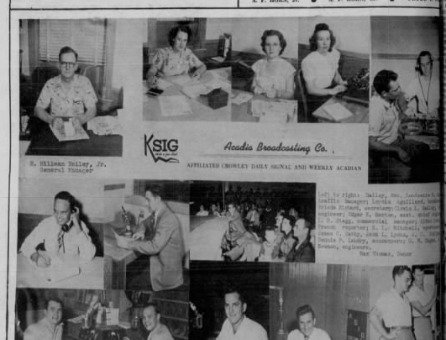
Advertisement for KSIG with pictures of the station’s staff. Hillman is on the top left and Clovis is the first person on the top right. | Source: The Crowley Post-Signal, September 3, 1949, newspapers.com.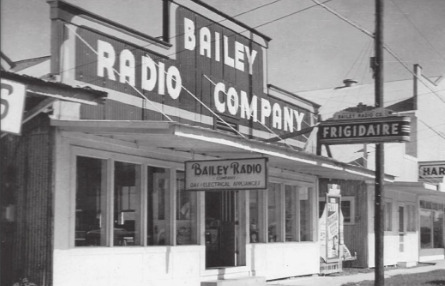
Where It Began
Photo of Bailey Radio Company taken in the 1930s. | Source: Tony Olinger, Images of America: Lost Rayne (Charleston, SC: Arcadia Publishing, 2015), 41.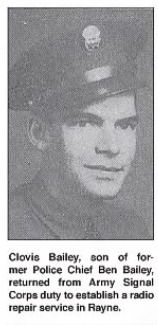
Man in Uniform
Photo of Clovis Bailey wearing his Army uniform after being drafted during World War II. | Source: Rayne Acadian-Tribune, July 25, 2019, newspapers.com.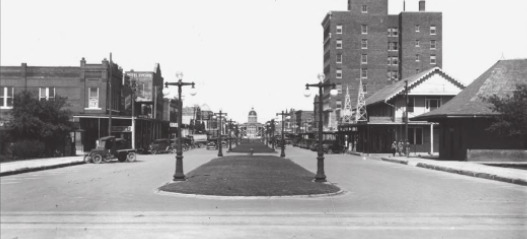
Daily Signal Meet KSIG
Parkerson Street in Crowley in 1930. The Daily Signal building, where KSIG was located, is on the left. | Source: Ann Mire, Images of America: Crowley (Charleston, SC: Arcadia Publishing, 2014), 14.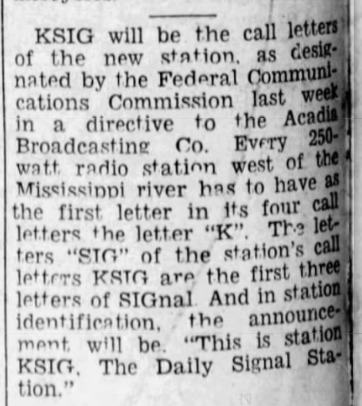
Behind the Call Sign
An article explaining the meaning of KSIG's call sign. | Source: Weekly Acadian, November 28, 1946, newspapers.com.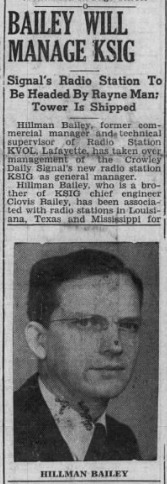
Signal on a Hill-man
An article announcing Hillman Bailey as KSIG's manager and describing his radio experience. | Source: Crowley Post-Signal, March 12, 1947, newspapers.com.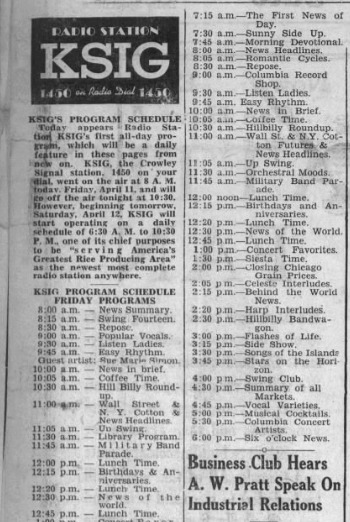
Program Schedule
The first program schedule for KSIG when it first went on air. | Source: Crowley Post-Signal, April 11, 1947, newspapers.com.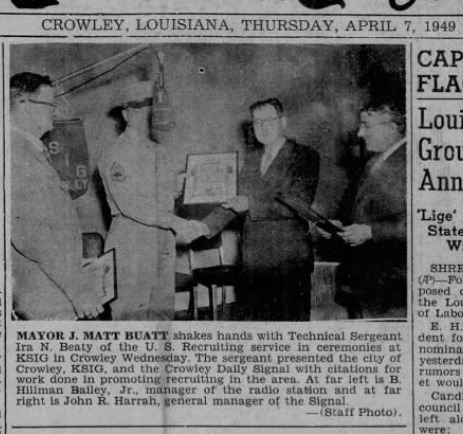
KSIG and Military Recruitment
KSIG was recognized with certificates for its military recruiting efforts during World War II. | Source: Crowley Post-Signal, April 7, 1949, newspapers.com.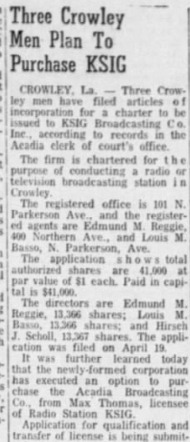
After the Baileys
An article describing the purchase of KSIG by three men including the station's future manager, Lou Basso. | Source: Crowley Post-Signal, April 23, 1955, newspapers.com.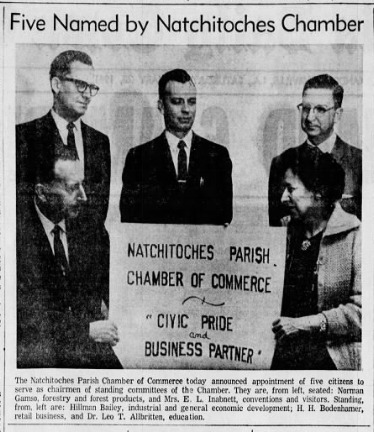
O Brother, Where Art Thou?
Standing on the left is Hillman, who was appointed to the Natchitoches Parish Chamber of Commerce as chairman of "industrial and general economic development." | Source: The Town Talk, January 28, 1961, newspapers.com.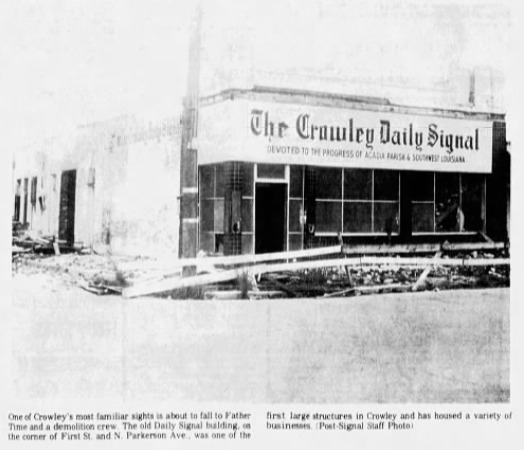
End of an Era
Photograph from the Crowley Post-Signal of the demolition of the old Daily Signal building. The second floor where KSIG was is faintly visible. | Source: Crowley Post-Signal, September 30, 1976, newspapers.com.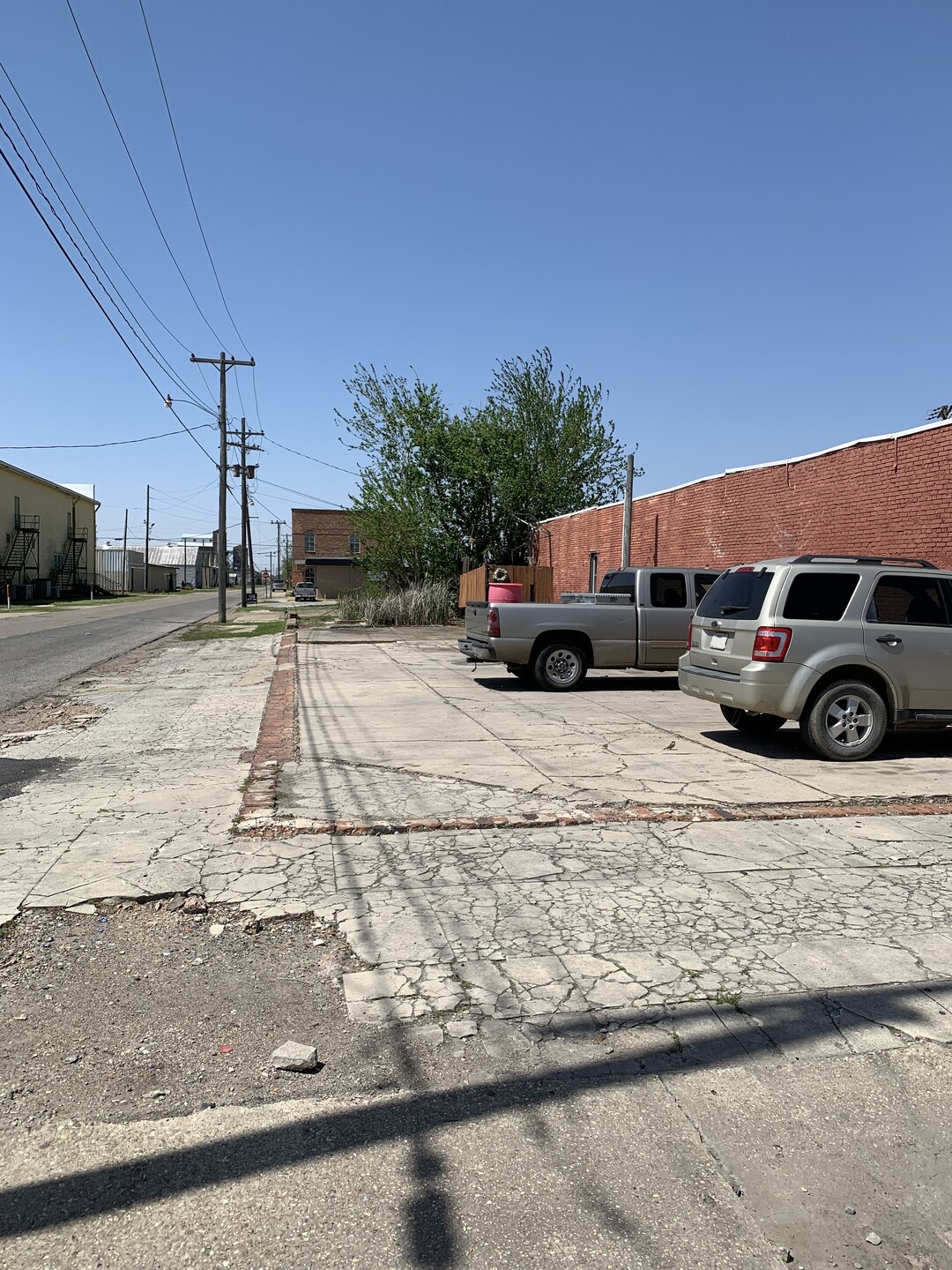
Remnants of the Signal
Photo of the former location of the KSIG/Daily Signal building on 101 Parkerson Avenue in 2022. Note the brick foundation on the ground. | Source: Photographed by Lindsey DeLaughter.