<?xml version="1.0" encoding="UTF-8"?>
<feed xmlns="http://www.w3.org/2005/Atom">
  <title type="text">Acadiana Historical</title>
  <updated>2026-05-08T17:25:16+00:00</updated>
  <generator uri="http://framework.zend.com" version="1.12.20">Zend_Feed_Writer</generator>
  <link rel="alternate" type="text/html" href="https://mail.acadianahistorical.org/"/>
  <link rel="self" type="application/atom+xml" href="https://mail.acadianahistorical.org/items/browse?output=rss2"/>
  <id>https://mail.acadianahistorical.org/</id>
  <author>
    <name>Acadiana Historical</name>
    <uri>https://mail.acadianahistorical.org</uri>
  </author>
  <link rel="hub" href="https://pubsubhubbub.appspot.com/"/>
  <entry>
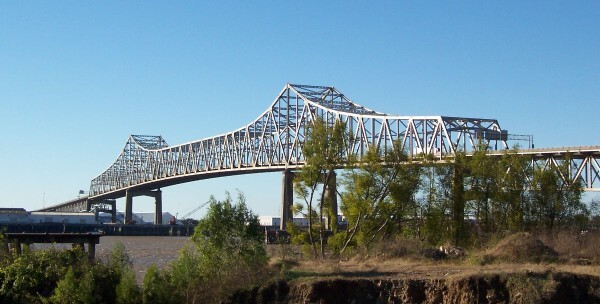
    <title type="html"><![CDATA[ Horace Wilkinson Bridge : A bridge that was welded and elevated to preserve the legacy of three generations. ]]></title>
    <summary type="html"><![CDATA[<p><strong><em>Horace Wilkinson Bridge is a bridge constructed to honor the legacy of three separate Horace Wilkinsons who served in the Louisiana Legislature for years. </em></strong></p><img src="https://mail.acadianahistorical.org/files/fullsize/972df96abc8d4459e7e2dc4734136076.jpg" alt="Horace Wilkinson Bridge " /><br/><p>Louisiana is a state rich in rivers, bayous, marshes, and wetlands, making bridges essential for travel. The state is home to some of the most impressive and unique bridges, including the Lake Pontchartrain Causeway, the Crescent City Connection, and the Huey P. Long Bridge. Louisiana is also home to the Horace Wilkinson Bridge, one of its most notable structures, welded  and elevated to reflect its significance.</p><p>The Horace Wilkinson Bridge, also known as the “New Bridge,” runs along Interstate 10, connecting Port Allen (West Baton Rouge Parish) to Baton Rouge (East Baton Rouge Parish). The 14,150-foot (2.5-mile) cantilever steel truss bridge rises 175 feet above the Mississippi River. It features a 4,550-foot superstructure and a 1,235-foot clear span, with an overall width of 500 feet. The bridge carries six lanes of traffic. Plans to build the bridge began in the early 1960s.</p><p>Before the Horace Wilkinson Bridge was built in 1968, travelers depended on the Huey P. Long–O.K. Allen Bridge, which opened in the 1940s and became known as the “Old Bridge.” Over the years, the region experienced an increase in highway and waterway traffic that the Old Bridge could no longer sustain. Traffic congestion and bottlenecks worsened, placing strain on Baton Rouge’s infrastructure. As a result, the Louisiana Department of Highways proposed and commissioned the construction of a “New Bridge” to reduce congestion throughout the region.</p><p>In 1960, plans to build the new bridge began. The Louisiana Department of Highways partnered with Modjeski and Masters, which designed the bridge, while construction was carried out by the American Bridge Company. On March 21, 1963, work began on the bridge’s substructure units. Three years later, in January 1966, contractors started on the superstructure. Construction was completed in February 1968, and the bridge opened on April 10, 1968. In total, the project cost $15,574,174.</p><p>Despite the bridge’s architectural significance and its role in reducing traffic congestion and expanding infrastructure, the Louisiana Legislature passed Act 206 of 1968 to officially name the “New Bridge” the Horace Wilkinson Bridge. The bridge was named to honor and preserve the memory of three generations of the Wilkinson family: Horace Wilkinson Sr. (1854–1941), Horace Wilkinson Jr. (1888–1966), and Horace Wilkinson III (1913–1961). They were father, son, and grandson, respectively, and all three served in the Louisiana Legislature. Collectively, they served a total of fifty-four years. In addition to their legislative service, they were prominent figures in the Baton Rouge metropolitan area.</p><p>Horace Wilkinson Sr. (1854–1941) was born on Point Celeste Plantation in Plaquemines Parish. Before entering politics, he was a well-known planter. In 1883, he married Julia Merwin of New Orleans and moved to West Baton Rouge. Between 1884 and 1900, he managed Poplar Grove Plantation in Port Allen before returning to Plaquemines Parish for three years. In 1905, he returned to West Baton Rouge and purchased Poplar Grove Plantation. Around this time, he became actively involved in his community.</p><p>Horace Wilkinson Sr. was an advocate for Louisiana’s agriculture and infrastructure. He served as a member of the West Baton Rouge Parish Police Jury, as president of the Atchafalaya Basin Levee Board, and as president of the Choctaw Drainage Board. He was also elected to the Louisiana Constitutional Convention and served for twenty-one years in the Louisiana Legislature.</p><p>During his time in the legislature, Horace Wilkinson Sr. advocated for improved drainage systems, bridges, and roads. In 1918, during the administration of Ruffin Pleasant, he introduced a bill to purchase the Gartness Plantation in south Baton Rouge; this land later became the site of Louisiana State University. During the administration of John Parker, Horace Wilkinson Sr. served as the manager of the Angola State Penitentiary.</p><p>As mentioned, the bridge is named after Horace Wilkinson Sr.’s son and grandson. Both Horace Wilkinson Jr. and Horace Wilkinson III also played important roles in the Louisiana Legislature. Horace Wilkinson Jr. (1888–1966) followed in his father’s footsteps. He was a well-known sugar planter who lived on Poplar Grove Plantation. Like his father, he served in the Louisiana Legislature for 16 years and was a member of the West Baton Rouge Police Jury. Horace Wilkinson Jr. also served on the LSU Board of Supervisors for fourteen years. He is credited with being the first planter in Louisiana to use sheep to control Johnson grass in sugarcane fields.</p><p>Horace Wilkinson III (1913–1961) attended LSU and graduated in 1936 with a degree in agriculture. Like his father and grandfather, he followed a career in public service. He served twelve years as a member of the West Baton Rouge Police Jury and became a member of the LSU Board of Supervisors in 1959. Horace Wilkinson III was also a member of the Farm Bureau, the American Sugar Cane League, the National Cattlemen’s Association, and Sigma Nu Fraternity.</p><p>He was active in Louisiana politics for several years and served as a Louisiana senator from 1952 to 1956. He was reelected in 1960 but died in 1961 before completing his term. In total, Horace Wilkinson III served ten years as a Louisiana senator. While delivering a speech in 1961, he died from a stroke.</p><p>Overall, the Wilkinson family contributed significantly to Louisiana politics, infrastructure development, and agricultural advancement. They were strong advocates for the state’s progress. The bridge was built in their honor and stands as a lasting tribute to their legacy.</p><p>The Horace Wilkinson Bridge is also a symbol of modern engineering advancements. It is one of the highest bridges that crosses the Mississippi River. Its cantilevered truss design allows it to support heavy loads while also providing clearance for ships navigating the river, helping to reduce ship-related accidents.</p><p>Despite the bridge’s impressive design and historical significance, travelers often face challenges when using it. Although it was built to help reduce traffic congestion, the route is now known for frequent daily traffic delays.</p><p>The increased volume of vehicles has led to traffic delays and accidents. The original design of the Horace Wilkinson Bridge allowed little room for emergency contingencies. In response, in recent years, efforts have been made to implement additional safety measures for the bridge. For example, in 2003, the merge between Interstate 10 East and Interstate 10 West was redesigned to improve traffic flow. However, heavy traffic congestion remains an ongoing issue.</p><p>Currently, efforts to improve the bridge and make it safer for travelers continue to be an important focus. The Horace Wilkinson Bridge is a significant structure in the Baton Rouge area. It represents the legacy of the Wilkinson family and their efforts to improve the region. Overall, the bridge stands as a symbol of human ingenuity and progress.</p><p><em><strong><a href="https://mail.acadianahistorical.org/items/show/327">For more (including 6 images) view the original article</a></strong></em></p>]]></summary>
    <published>2026-04-27T22:59:58+00:00</published>
    <updated>2026-05-07T22:35:31+00:00</updated>
    <link rel="alternate" type="text/html" href="https://mail.acadianahistorical.org/items/show/327"/>
    <id>https://mail.acadianahistorical.org/items/show/327</id>
    <author>
      <name>Jaquala Hebert </name>
    </author>
  </entry>
  <entry>
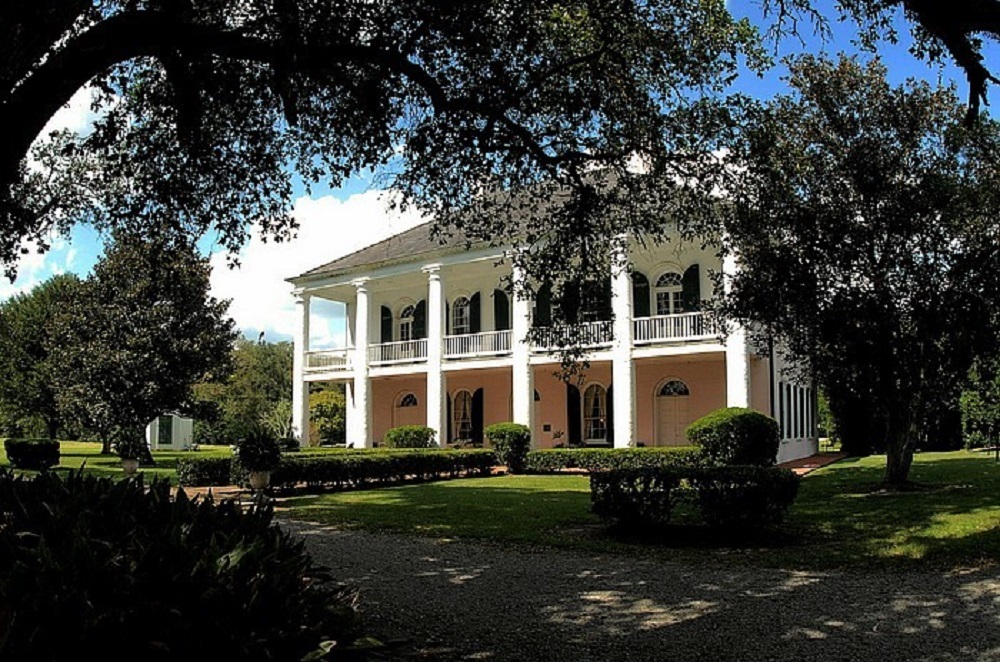
    <title type="html"><![CDATA[&quot;I&#039;ll see your hundred and raise you twenty.&quot;: Chretien Point Plantation and its Mistress ]]></title>
    <summary type="html"><![CDATA[<p><strong><em>Félicité Chretien is not a woman to mess with.</em></strong></p><img src="https://mail.acadianahistorical.org/files/fullsize/17765bf952d77980c60c2d4dc70859c8.jpg" alt="Chretien Point Plantation Mansion." /><br/><p>Near the banks of Bayou Bourbeuax, amongst the fields of Sunset, stands a 12-room mansion at the heart of what used to be a 3,000-acre cotton plantation.  Construction of the mansion began in 1831 by a man named Hypolite Chretien II and the mansion, along with the cotton fields, was named Chretien Point Plantation.  Shortly after the completion of construction, Hypolite and his youngest passed away from yellow fever.  He left behind his wife, Félicité Neda Chretien, and four small children.</p><p>Félicité Chretien was a very strong-willed, attractive lady who regularly participated in what was traditionally “men only” activities such as smoking and gambling.  In that day and age, women did not live alone or throw parties or manage plantations, but Félicité, a “man’s woman,” wasn’t afraid to do all those things.  She was very good gambling and could increase her land by winning many games.</p><p>News spread quickly about Félicité living alone without a man, and many desired to take her fortune.  One dark night, a gang of men attempted to rob the house, but Félicité stood guard to protect her family and her home.  When Félicité heard the men approaching, she quickly grabbed her gun and rushed down the stairs.  With no time to wake and get the help of her servants, Félicité confronted the intruder herself.  She yelled at him to stop but he continued to advance and when he was in close enough range, she shot the man in the head and killed him.  With one man down and several more coming across the lawn, Félicité ran to awaken her men and arm them so they could help protect the house.</p><p>The other men continued to move toward the house.  Félicité told them to leave and they replied with “We are looking for our friend.”  Félicité said he was not there and that they would be shot if they did not leave and get off her property.  The gang fled, leaving their friend behind.  The next morning, Félicité had her maids clean and scrub the floor where the intruder bled to death and called the police to take the body away.  The maids scrubbed in vain but they couldn’t get the stain out.  Félicité later moved to New Orleans, where she passed away, and left the plantation to her son.</p><p>Today, the blood stain remains on the floor just in front of the stairs and serves as a reminder of Félicité’s strong will and bravery.  It is rumored that the intruder can still be felt inside the mansion or seen coming across the lawn.  Despite not having died in the house, visitors can also catch a glimpse of Félicité as she continues to stand her ground.  And if it is quiet enough, the echoes of Félicité’s poker voice can still be heard throughout the mansion saying, “I’ll see your hundred and raise you twenty.”</p><p><em><strong><a href="https://mail.acadianahistorical.org/items/show/75">For more (including 10 images) view the original article</a></strong></em></p>]]></summary>
    <published>2018-05-05T17:51:38+00:00</published>
    <updated>2026-03-04T22:42:47+00:00</updated>
    <link rel="alternate" type="text/html" href="https://mail.acadianahistorical.org/items/show/75"/>
    <id>https://mail.acadianahistorical.org/items/show/75</id>
    <author>
      <name>Nina M. Hoffpauir</name>
    </author>
  </entry>
  <entry>
    <title type="html"><![CDATA[&quot;Keep Holy Rosary Alive&quot;: Holy Rosary Institute ]]></title>
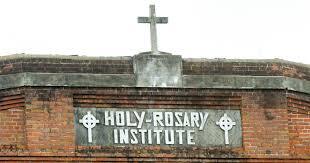
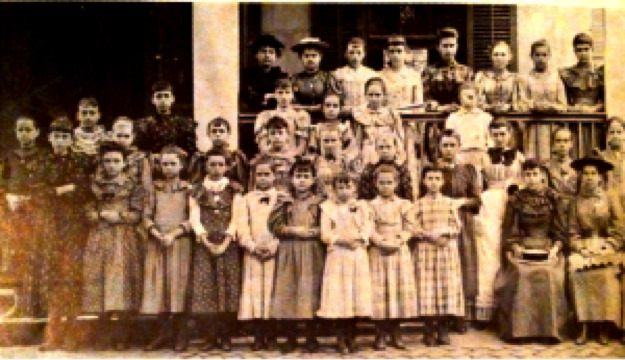
    <summary type="html"><![CDATA[<p><strong><em>Historic school in Louisiana for African Americans strives to stay open for good. </em></strong></p><img src="https://mail.acadianahistorical.org/files/fullsize/cd0b6a3c8129d7d894f42feaf8e506b3.jpg" alt="[Untitled]" /><br/><p>It was during the last quarter of the nineteenth century in 1913, the prestigious Holy Rosary Institute opened its doors. It began as an industrial school for young African American woman in Galveston, Texas then later on in the year it moved to Lafayette, Louisiana. In 1947 the school got so much attention that it started to admit males along with the women. During its time in Lafayette, Louisiana it served as a vocational-technical school by providing a unique education that wasn’t offered to the African Americans. In 1974, there was a decline in enrollment, which caused the boarding department of Holy Rosary to close thus ending a notorious era that begun more than fifty years ago. The alumni and friends of Holy Rosary decided to put forth effort to “Keep Rosary Alive” because of the needs of the school. Unfortunately, all the efforts weren’t enough to keep the school open. In 1993, after more than eighty years of service, financial and several other socio-economic issues led to the closure of one of the most prestigious, college-preparatory schools in the south. If it weren’t for Holy Rosary Institute influence the socio-economic development of Southwest Louisiana would have been very different.  </p><p><em><strong><a href="https://mail.acadianahistorical.org/items/show/43">For more (including 3 images&#32;&amp;&#32;1 audio file) view the original article</a></strong></em></p>]]></summary>
    <published>2018-04-26T15:43:10+00:00</published>
    <updated>2026-03-04T22:42:46+00:00</updated>
    <link rel="alternate" type="text/html" href="https://mail.acadianahistorical.org/items/show/43"/>
    <id>https://mail.acadianahistorical.org/items/show/43</id>
    <author>
      <name>Kristen Angelle Harrison</name>
    </author>
  </entry>
  <entry>
    <title type="html"><![CDATA[&quot;Lafayette Sports Hero&quot; J.C. Reinhardt ]]></title>
    <summary type="html"><![CDATA[<img src="https://mail.acadianahistorical.org/files/fullsize/8bebe31c07009cd36c008a95036d9994.jpg" alt="[Untitled]" /><br/><p>J.C. Reinhardt, a graduate from The University of Iowa, who was hired in 1931 came to Lafayette, Louisiana and totally changed the dynamics of local sports. He was brought in to be the head basketball coach, freshman football coach, tennis coach, intramural sports director, health and physical education instructor, trainer and director of the barracks dorm for athletes. During his time in lafayette he started a foundation in the 1970’s for basketball programs to develop, this formed after he’d retired from coaching in 1957.Before the completion of Blackham Colosseum in 1950, Reinhardt and his players had to visit wooden gyms to play games and if the facilities were occupied with other social events they would get kicked out. At the time basketball wasn’t a popular sport so there was no priority for games to be held. His overall coaching record was 346 victories and 253 losses and from what we know about Reinhardt, he had a passion for young lives and creating opportunity. He found a way to make work scholarships for his players; the method was to do things such as: clean up, mow the lawn or even sell programs at football games. Whatever there was a need he saw it fit for his athletes in order to create doors for their future. Fifty years after the Southwestern Louisiana Basketball Program was nationally known, the city of Lafayette decided to name a street after him. </p><p><em><strong><a href="https://mail.acadianahistorical.org/items/show/71">For more (including 2 images) view the original article</a></strong></em></p>]]></summary>
    <published>2018-05-03T19:43:10+00:00</published>
    <updated>2026-03-04T22:42:47+00:00</updated>
    <link rel="alternate" type="text/html" href="https://mail.acadianahistorical.org/items/show/71"/>
    <id>https://mail.acadianahistorical.org/items/show/71</id>
    <author>
      <name>Brennon Rami </name>
    </author>
  </entry>
  <entry>
    <title type="html"><![CDATA[&quot;Saddest Funeral on the Teche&quot;: Mount Carmel Academy ]]></title>
    <summary type="html"><![CDATA[<p><strong><em>A terrible funeral for a historic school.</em></strong></p><img src="https://mail.acadianahistorical.org/files/fullsize/fc0307117759e38443fcd66eb8f01636.jpg" alt="Vintage pic of the first class of the academy. " /><br/><p>The small town of New Iberia, Louisiana has a unique secret that thrives inside this local high school. Over 170 years ago Mount Carmel Academy opened its doors! The academy was originally for girls and helping with their development. The historic school was once home to Doctor Frederick Duperier of New Iberia in 1850. He holds a well-known artifact that lies in the heart of the Academy. The famous artifact is known as “The Emma Window,” which is a window scratched up by his wife’s engagement ring. Throughout the years Mount Carmel acted as a home for over a thousand girls in Southwest Louisiana. The school was such a success that they were able to produce a graduating class in 1890. It consisted of so many talented and educated sisters that the owner of the brother school, St. Peter’s College, Father Jouen asked for them to teach his young men for a couple of years. When the school initially moved, it renamed to Catholic High School. In 1987, New Iberia accomplished a very important milestone of incorporating young girls into the school. Unfortunately in 1988, after the closing of the academy, the structure remained abandoned for several years until the Schellestede family of New Iberia bought it. Now the building has been converted into an administrative office used by Catholic High. Mount Carmel Academy’s legend will live on along the Bayou Teche!</p><p><em><strong><a href="https://mail.acadianahistorical.org/items/show/48">For more (including 5 images) view the original article</a></strong></em></p>]]></summary>
    <published>2018-04-26T15:48:02+00:00</published>
    <updated>2026-03-04T22:42:46+00:00</updated>
    <link rel="alternate" type="text/html" href="https://mail.acadianahistorical.org/items/show/48"/>
    <id>https://mail.acadianahistorical.org/items/show/48</id>
    <author>
      <name>Kristen Angelle Harrison </name>
    </author>
  </entry>
  <entry>
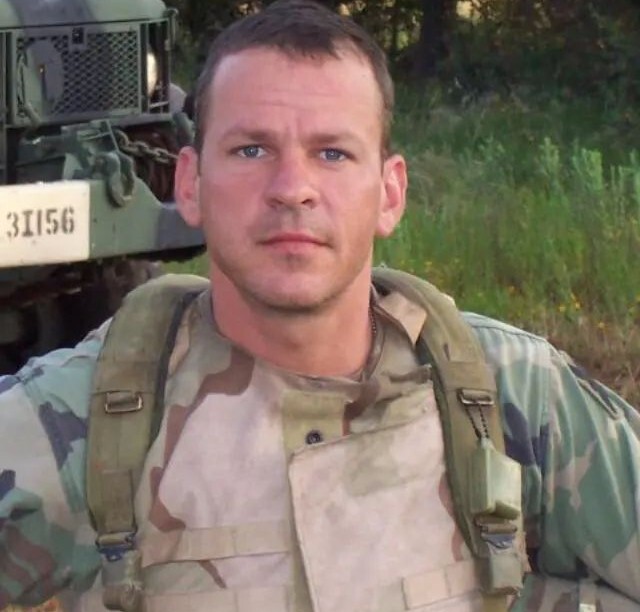
    <title type="html"><![CDATA[&quot;The Blessed Company:&quot; SSG William Francis ‘Bill’ Manuel Memorial Highway and Overpass: U.S. Highway 165]]></title>
    <summary type="html"><![CDATA[<p><strong><em>Louisiana Memorial Highway number 93 is known as the SSG William Francis ‘Bill’ Manuel Memorial Highway and is a portion of U.S. Highway 165 in Kinder, Louisiana. This is also the location of the casino that Manuel worked at before deployment. Leading up to the highway is the overpass also named after him.</em></strong></p><img src="https://mail.acadianahistorical.org/files/fullsize/3629324436d8b7b4ea76dfeda00921f3.jpg" alt="Photo of SSG Manuel " /><br/><p>This article recounts the story of the death of SSG William Manuel and SSG Robert Sweeney III on January 10, 2005, in Iraq as part of their service to their country during Operation Iraqi Freedom. This article contains subject matter that some may find distressing. Please note that this article’s purpose is to honor the sacrifices of these brave men who were involved and to ensure that they are not forgotten. </p><p>       William Francis ‘Bill’ Manuel was born February 27, 1970, in Oberlin, Louisiana to Kermit and Shirley Manuel. He attended Oberlin High School and McNeese State University in Lake Charles, where he received a bachelor's degree in criminal justice. In 1995, he began working at the Grand Casino Coushatta in Kinder around the time of its grand opening. Manuel was a remarkable man of faith, having been an altar server at St. Joan of Arc Catholic Church for eleven years and later a member of St. Phillip Neri Catholic Church in Kinder. </p><p>       Manuel enlisted and was assigned to the 256th Infantry Brigade Combat Team of the Louisiana Army National Guard at the time of the first Persian Gulf War. He trained at Fort Hood in Killeen, Texas and Fort Irwin in California before being deployed to Iraq in 2004 as part of Operation Iraqi Freedom. He was a member of Hard Rock Charlie Company, 3rd Battalion of the 156th Mechanized Infantry Regiment that was based out of Camp Liberty near the Baghdad airport. </p><p>         After a series of near misses from missiles and other explosives during their time out in the field, Manuel and his men felt as if they were protected by God as they prayed daily for safety. He worked closely with 1st LT Brian Stevens of Baton Rouge, SFC Orise Cormier of Oberlin, SSG Thomas Berryhill of Pineville, SSG James Johnson of Lake Charles, SGT Cletus Baber, SGT (promoted to SSG after death) Robert Sweeney III of Pineville, SGT Blake Quebedeaux of Leonville, SGT Jack Gunter of Natchitoches, SGT Cezar Francis studying at Northwestern State University, SGT Gary Walters of Sulphur, CPL Eric Sessions of Lake Charles, SPC Matthew Carnicle of Deville, SPC Kyle Pilley of Natchitoches, and SPC James Tidwell of Ville Platte. The following story was reported by the survivors the day it happened. </p><p>       On the morning of January 10th, 2005, Manuel returned to Camp Liberty with a damaged Bradley Fighting Vehicle (a tracked armored fighting vehicle). He spoke with Cormier who told him to be careful. “’Don’t worry. Three-two never gets hit,” he [SSG Manuel] said, using the numerical designation for his Bradley. “Nobody wants a piece of three-two.’” Manuel and his men set off again in another Bradley accompanying Berryhill’s lead Bradley. An explosion from an IED (improvised explosive device) ripped through the desert and Manuel’s Bradley burst into flames. Hundreds of the squad’s own rounds of 25mm had been lit by the flames and pelted the inside of the Bradley. </p><p>     The first Bradley, driven by Pilley stopped, Carnicle and Quebedeaux jumped out to save their squadmates. Sessions was the first out, opening the top hatch in a daze. He was interrupted by a scream from Walters, trapped in the gun turret by one crushed and one fractured ankle. Carnicle shouted for Sessions to drop the back ramp that only came down partially because of the damage the Bradley took in the attack. Johnson, covered in oil, face and leg battered by shrapnel, with a broken kneecap, was standing at the back of the Bradley where he was struggling to rescue Sweeney. Quebedeaux and Berryhill stepped in as Johnson collapsed from exhaustion. Sweeney was dead and the men prayed over him. </p><p>      Meanwhile, Sessions, who was not wounded, dodged bullets and flames and climbed back into the Bradley. He rescued Walters and set him down on the ground, joining Quebedeaux and Stevens in the pursuit of Manuel, who had been last seen inside reaching for something within the Bradley. They opened the hatch, and the smoke cleared just enough for them to see where the IED had exploded and left a hole in the floor of the Bradley. Manuel was dead and they were unable to rescue his body at that time. Still inside the Bradley, Baber regained consciousness as he was drenched in diesel fuel. He carefully avoided the flames and rescued Tidwell and escaped the Bradley. Once the others were out, they radioed for help and the medevac helicopters arrived.</p><p>     These 14 soldiers were recommended for medals of valor, “up to and including the Distinguished Service Cross, second only to the Medal of Honor among combat awards.” However, some struggled with the thought of even getting inside of another Bradley. Berryhill told Carnicle “You have to. You don’t have a choice. I’m going to have to go back, too. It’s what the men who died would have wanted.” The wounded men were already in route to Louisiana. Those still in were thankful to be alive and lived out the rest of their careers in honor of those they loved on that cold January morning in Baghdad.</p><p>     At Manuel’s funeral, retired SGT Nora Popillion recounted how the two would sit on the second story of the tower at Fort Polk, smoking cigars and listening to zydeco music. He said Manuel would tell those attending his funeral, “Bury me. Honor me, but live ... I lived a good life.” A week before the deaths of Manuel and Sweeney, SPC Bradley Bergeron, SGT Christopher Babin, and PFC Armand Frickey, all of Houma, SPC Warren Murphy of Marrero, SPC Huey Fassbender III of LaPlace and SFC Kurt Comeaux of Raceland had been killed in another blast.</p><p><em><strong><a href="https://mail.acadianahistorical.org/items/show/272">For more (including 12 images&#32;&amp;&#32;1 audio file) view the original article</a></strong></em></p>]]></summary>
    <published>2025-04-27T19:20:47+00:00</published>
    <updated>2026-03-04T22:42:50+00:00</updated>
    <link rel="alternate" type="text/html" href="https://mail.acadianahistorical.org/items/show/272"/>
    <id>https://mail.acadianahistorical.org/items/show/272</id>
    <author>
      <name>Kallie R. Barron </name>
    </author>
  </entry>
  <entry>
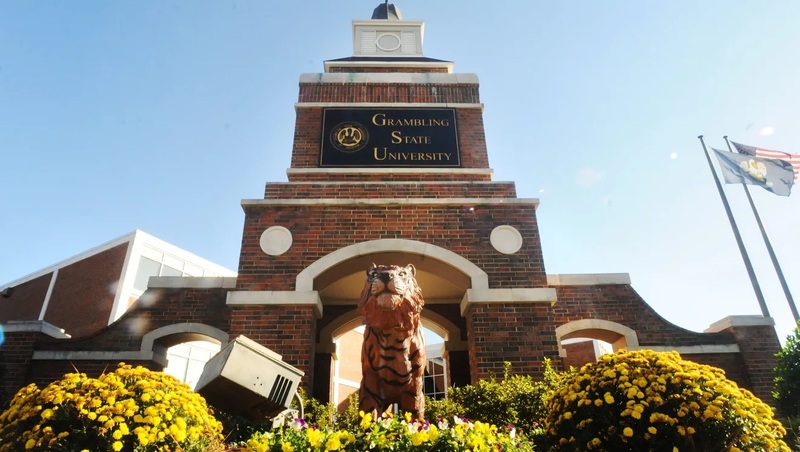
    <title type="html"><![CDATA[“The Place Where Everybody Is Somebody”: State Representative Pinkie Wilkerson Memorial Interchange: I-20 &amp; LA 149 interchange in Grambling, Louisiana]]></title>
    <summary type="html"><![CDATA[<p><strong><em>Louisiana Memorial Highway 148 is named the State Representative Pinkie Wilkerson Memorial Interchange. The small connection located at the intersection of Interstate 20 and Louisiana Highway 149, sits north of Grambling, Wilkerson’s hometown. House Bill 104 was passed in 2015 which designated the piece of road in her name. Wilkerson advocated for better lighting in the Louisiana legislature at the exact I-20 exit to commemorate her contributions to and in Grambling.</em></strong></p><img src="https://mail.acadianahistorical.org/files/fullsize/ad33582bd9d42270c520322bf1451681.jpg" alt="Photograph of Grambling State University in Grambling, Louisiana." /><br/><p><p style="font-weight:400;">Pinkie Carolyn Wilkerson was a Gambling native through and through. She was born in Grambling on February 8, 1948, and spent her whole life indebted to the location. Both of her parents were teachers. Her father, Calvin, was fired from his teaching position for getting individuals registered to vote in the 1950s. He became a merchandise peddler to make ends meet for his family. His peddling turned into a sport’s merchandise and high-end clothing business, named the Collegiate Shoppe, in 1957. The business allowed Calvin, a first-generation college student, to support students in need—providing them with books and professional clothing, at little to no cost. The Collegiate Shoppe would close 67 years later in 2024. Yet, the store gained its name from the college town that it resided in—Grambling, Louisiana.
<p style="font-weight:400;">Grambling State University (GSU), a public historically black college, is Grambling’s main attraction. The 124-year-old institution started as a way for rural Black farmers to educate one another, but it has grown into one of the most renown Historically Black Colleges and Universities (HBCU) in the United States. Wilkerson attended Grambling State University Lab High School, the high school attached to the university.<span>  </span>After high school, Wilkerson attended University classes at Grambling, later graduating with her bachelor’s degree (B.A).
<p style="font-weight:400;">After attending Grambling State University, Pinkie Wilkerson moved away temporarily to pursue a master’s degree (M.A.) in Ohio at Ohio State University. But after two years, she returned back to Louisiana, where she went on to receive a Juris Doctrine (J.D.) from Southern University School of Law in Baton Rouge in 1979. After finishing top of her class, Wilkerson continued her education in Louisiana getting a Master of Laws (LL. M.) degree from Tulane University School of Law in New Orleans. She returned to Grambling, Louisiana to open her own practice in 1979—later earning the title of assistant district attorney for Lincoln and Union Parishes. She then served as the assistant attorney general for the State of Louisiana. In addition to being a fantastic lawyer, she was an accomplished academic professor. Wilkerson taught law, business law, American history, and American government at several universities across the United States, including Grambling State University where she was an assistant professor.
<p style="font-weight:400;">In 1992, Wilkerson was elected to the State Legislature, becoming the first black state representative for Louisiana’s District 11. In her eight-year tenure in the House of Representatives, she supported legislation on social issues, education, and rural issues. In 1993, Wilkerson supported the creation of a 24-hour statewide compulsive gamblers helpline. With its requirement to be displayed on all casinos and advertisements for gambling and lottery tickets, this legislation has helped millions of people. Wilkerson’s legislative colleagues respected her ability to not give up on her constituents, accessing all the resources and funds she could for her district and hometown. She made history in 1997 becoming the first and only woman to chair the Rural Caucus of the Louisiana legislature. She was active in many committees during her time in Congress, like the Health and Welfare committee, Civil Law and Procedure committee, and the House Judiciary—where she was vice chairman of all these. Wilkerson was also a proud member of the Women’s Caucus, during her entire term in the Louisiana legislature. She was an avid supporter of women, advocating for domestic violence prevention. She was also the president of National Bar Association’s Women Lawyers Division and the League of Women Voters in the Ruston-Grambling area, where she followed in her father’s footsteps to promote voting rights.
<p style="font-weight:400;">Wilkerson remained an active legislator until her death on August 1st, 2000. Wilkerson’s vehicle was stuck from behind by a truck while stopped for construction on I-20—the same road that would wear her name two decades later—in Bossier City, Louisiana. Her funeral service itself took place on the campus of GSU, furthering solidifying Wilkerson’s ties to the college and town. Today, Wilkerson’s legacy lives on in Grambling through numerous scholarship funds named in her honor.</p><p>While Grambling is known as “the place where everybody is somebody,” Pinkie Wilkerson is not just somebody to her state, hometown, college, and community. She is somebody to remember.</p><p><em><strong><a href="https://mail.acadianahistorical.org/items/show/253">For more (including 11 images&#32;&amp;&#32;1 audio file) view the original article</a></strong></em></p>]]></summary>
    <published>2025-03-06T09:20:28+00:00</published>
    <updated>2026-03-04T22:42:50+00:00</updated>
    <link rel="alternate" type="text/html" href="https://mail.acadianahistorical.org/items/show/253"/>
    <id>https://mail.acadianahistorical.org/items/show/253</id>
    <author>
      <name>Caroline Dugan</name>
    </author>
  </entry>
  <entry>
    <title type="html"><![CDATA[A (Huey P.) Long Story: Sam Houston Jones Parkway: LA Highway 378 through Moss Bluff, Louisiana]]></title>
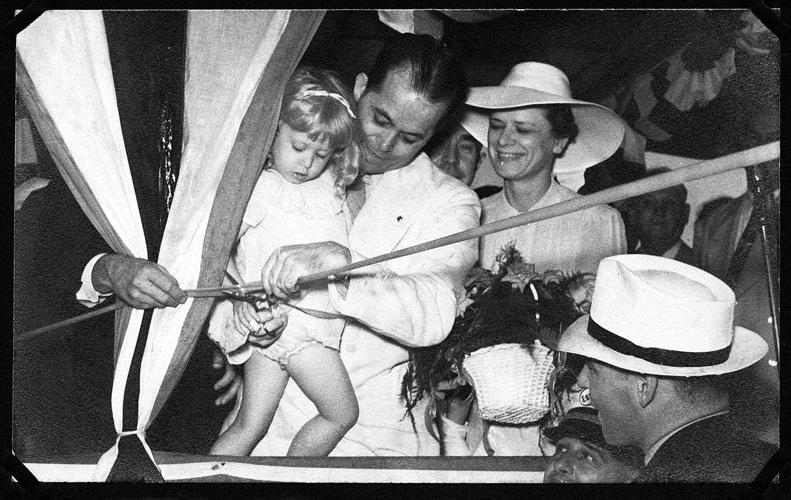
    <summary type="html"><![CDATA[<p><strong><em>Louisiana Memorial Highway 18 is named the Sam Houston Jones Parkway. The horizontal portion of Louisiana Highway 378 (LA 378) located in northeast Calcasieu Parish is dedicated in Sam Houston Jones’s honor. The parkway runs from Louisiana Highway 171 in Moss Bluff to Sam Houston Jones State Park. Jones worked to historically preserve the area of Calcasieu Parish, where the parkway is located.</em></strong></p><img src="https://mail.acadianahistorical.org/files/fullsize/2b02586a136348e424357d9d52f78ea3.jpg" alt="Gov. Jones and daughter" /><br/><p>Sam Houston Jones was born on July 15, 1897, in Merryville, Louisiana—a small town near DeRidder along the Texas-Louisiana border in Beauregard Parish. He graduated from DeRidder High School in 1915, as the valedictorian and class president. He studied at Louisiana State University (LSU) in Baton Rouge for two years but enlisted in the United States Army before receiving his graduation diploma. It is unknown if or when Jones completed an undergraduate degree, however, he excelled in the Army Reserve Officers Corps during World War I, a global conflict which lasted from 1914 to 1918. He entered the infantry, while spending most of his service at a nearby base, named Camp Beauregard, in Pineville, Louisiana. </p><p>After World War I, Jones returned to Baton Rouge, Louisiana and attended law school at LSU in 1919. Before graduating, Jones became involved and interested in local politics, serving as a delegate at the Louisiana Constitutional Convention of 1921. Jones was one of the 128,000 voting delegates which approved the new constitution. Within a year, Jones obtained a license to practice law in 1922; he took night classes to finish law school while working as a clerk of court during the day. He practiced law in DeRidder until 1924 when he moved to the city of Lake Charles, Louisiana. In Lake Charles, Jones practiced law before rising to district attorney of Calcasieu Parish in the 14th Judicial District, where he served from 1925 to 1934. </p><p>By August 1939, Jones had established quite the reputation as a rising politician. He was approached by the opposition of Huey P. Long Jr., who was Louisiana’s governor from 1928 to 1932 then a U.S. Senator from 1932 to 1935 when he was assassinated. Long changed Louisiana Politics through left-wing populist ideas of social reform from voting and educational improvements and economic wealth redistribution through state-funded taxes and tariffs. No other Louisiana governor had the same effect on Louisiana, creating the idea of a “Long dynasty” with several of Long’s relatives riding his coattails into political office. For this reason, anti-Long supporters wanted Jones to run for governor against Long’s brother, Earl, in 1940. Jones was hesitant to agree, knowing the power that the Longs held. Jones’s platform focused on honesty and honed in on the scandals and corruption of the Long years. They even compared Earl’s potential time in office to the previous Governor Richard Leche, Huey Long’s Successor who was convicted and imprisoned for misusing federal funds. Earl Long was Leche’s lieutenant governor from 1936 to 1939. While Earl held the lead vote during majority of the primary race, his reign splintered on the support of James Noe—the third gubernatorial candidate who was a former supporter of the Long family but supported Jones in the end. Jones won the runoff election in 1940, marking the end of the Long’s 12-year hold of the Louisiana governor’s office. On May 14, 1940, Jones was elected governor by popularity. </p><p>During his time in state office, Jones is most known for creating civil service legislation that restructured the government into a civil service system, with reductions to state agencies and state employment. While cutting some employment opportunities, he also raised the pay of teacher’s salaries and continued to raise the Long economic welfare programs, like free lunches for school children, equal pay among race for educators, and surpass funding for state and public colleges. Without name-recognition or politicking, Jones restored Louisiana’s image of an honest and respectful government. Jones called for fair, honest elections with the elimination of annual voter registration. He also implemented the voting machine system and pioneered a bidding system for state contracts and purchases to ensure anti-fraud. </p><p>At the same time that his political career was taking off, Jones’s family life was in full swing. He married a woman from DeRidder named Louise Gambrell Boyer in 1925. Boyer was a supportive wife and governmental ambassador. She was once introduced as the “Governor of the Governor of Louisiana” at a delegate dinner at the American Embassy in Mexico City in 1941. Jones and Boyer had four children, two during their marriage—Carolyn and Robert “Bobby” Jones—and two children who were adopted from Boyer’s previous marriage—James “Jimmy” and William “Bill” Boyer. </p><p>Jones did not seek an immediate second term. At the time, Louisiana’s constitution prohibited the secession of the incumbent governor after his term to avoid a hold on the seat. Therefore, Jones continued in office until May 9, 1944, when he was replaced by country music singer Jimmie Davis. Davis’s popular song “You Are My Sunshine” skyrocketed into popularity during Jones’s administration in 1940. Jones left Davis’s administration with a reduced debt and a substantial, $15 million-dollar, state treasury surplus—the first to do so in the last forty years. Jones was so financially responsible with monetary consolidation, that he would later serve on intergovernmental relations committees for commerce and research in the 1950s. Jones attempted another gubernatorial run in 1948, against Earl Long again, but lost. Historians claim that Long was able to “out promise” Jones on his campaign run. The Long name would hold the office seat again on May 11, 1948. Jones would never seek a second run for governor again. </p><p>Jones returned to Lake Charles in the early 1940s, after his brief time in higher office. He raised his family there for the next 40 years. Jones passed away on February 8, 1978. He is buried in Lake Charles at the Prien Memorial Park Cemetery. </p><p>The same year as his death in 1978, The Louisiana Senate passed a measure to rename the Sam Houston State Park near Lake Charles, in Moss Bluff, Louisiana. The park was originally named for Sam Houston, a Texas statesmen known as a pioneer of the Texas Revolution. Houston enjoyed traveling extensively to regions of west Louisiana—including Lake Charles. A high school of the same name is recognized down the street of the Louisiana state park. In 1934, Louisiana passed legislation to establish a state park system named the State Parks Commission of Louisiana. After its formation, seven sites were acquisitioned for public use, as state parks. With World War II in full effect and recreation funds on the decline, a new park development was declined for one new park site—Sam Houston State Park. However, by 1944, Sam Houston State Park received its official title and public opening. Jones, as acting governor, fought tirelessly for the land, in hopes to create the first and only state park in Southwest Louisiana. He was the driving force behind its designation. Since 1978, the park has honored his efforts for the land. </p><p>In addition to the park, Jones was honored in 1987 with a memorial highway in his name. The highway named the Sam Houston Jones Parkway was the first dedication by Governor Charles “Buddy” Roemer on July 11, 1988. Other politicians, like Senator Bill McLeod of Lake Charles, Representative Vic Stelly of Moss Bluff, and the President of the Calcasieu Parish Police Jury, Don Manuel all helped honor Jones. McLeod began brainstorming the highway expansion project of Louisiana highway 378 (LA 378) sixteen years prior. He knew that Jones was a fit honoree for the highway due to his contributions to the Lake Charles area and the state of Louisiana. The highway, a three-mile portion of LA 378 officially named after Jones, leads to the state park named after him—Sam Houston Jones State Park.</p><p><em><strong><a href="https://mail.acadianahistorical.org/items/show/278">For more (including 9 images&#32;&amp;&#32;1 audio file) view the original article</a></strong></em></p>]]></summary>
    <published>2025-05-04T20:46:10+00:00</published>
    <updated>2026-03-04T22:42:50+00:00</updated>
    <link rel="alternate" type="text/html" href="https://mail.acadianahistorical.org/items/show/278"/>
    <id>https://mail.acadianahistorical.org/items/show/278</id>
    <author>
      <name>Caroline Dugan</name>
    </author>
  </entry>
  <entry>
    <title type="html"><![CDATA[A Father and Son]]></title>
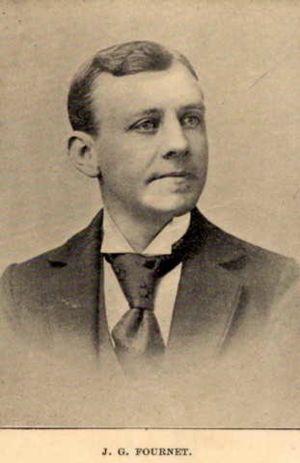
    <summary type="html"><![CDATA[<p><strong><em>Fournet street was named in honor of a father and son that had a very similar life.</em></strong></p><img src="https://mail.acadianahistorical.org/files/fullsize/2facee0c8aacaaacc66edc4b05281963.jpg" alt="Joseph Fournet" /><br/><p>Fournet street is currently located in Lake Charles, Louisiana. Fournet is named after a father and his son. Gabriel Fournet is the father of Joseph Fournet. Gabriel graduated from Georgetown College in 1861. He then entered the military during the civil war as a major of the Yellow Jacket Battalion in 1862. In 1866 he decided to go back to St Martinville and practice law. During this time Gabriel was very involved in the city. He was an editor for a newspaper and a clerk of court. Also in 1866 he took the bar in New Orleans to continue his practice in law. In 1870 Gabriel has his son Joseph. His son Joseph had just as much of an impact as he did. In 1880 Gabriel moved back to Lake Charles in 1893 with his family. Joseph graduated from Tulane University. When he returned to Lake Charles he opened up his own law firm. Gabriel’s wife passed away in 1893, and then 15 years later Gabriel passed. Gabriel and Joseph both come from very respected family from several generations. The street Fournet Street is named in their honor because of the impact they had on the community itself. </p><p><em><strong><a href="https://mail.acadianahistorical.org/items/show/33">For more (including 2 images) view the original article</a></strong></em></p>]]></summary>
    <published>2018-04-26T15:25:37+00:00</published>
    <updated>2026-03-04T22:42:46+00:00</updated>
    <link rel="alternate" type="text/html" href="https://mail.acadianahistorical.org/items/show/33"/>
    <id>https://mail.acadianahistorical.org/items/show/33</id>
    <author>
      <name>Hannah Bryan</name>
    </author>
  </entry>
  <entry>
    <title type="html"><![CDATA[A Grandiose Building with a War-Torn Past: St. Landry Catholic Church in Opelousas, LA]]></title>
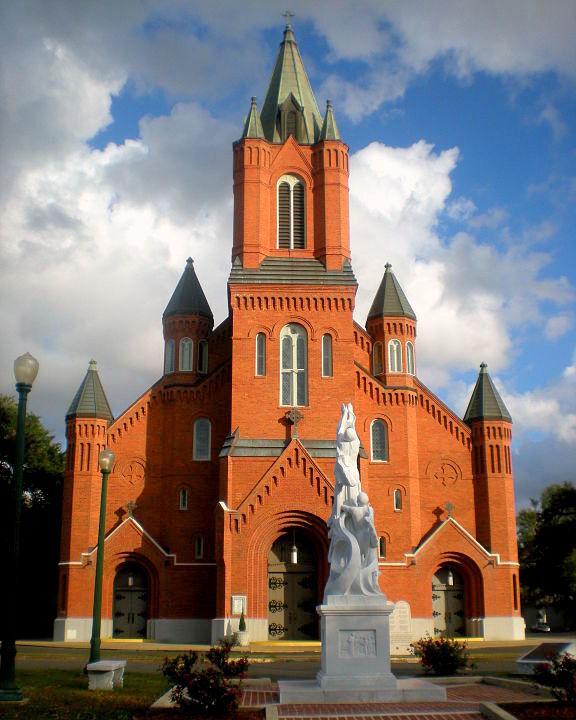
    <summary type="html"><![CDATA[<p><strong><em>This immense and ornate church holds centuries of stories which tell the impact of wars on Acadiana.</em></strong></p><img src="https://mail.acadianahistorical.org/files/fullsize/50c20f5e6e8e60ac0caf14d0da00e104.jpg" alt="St. Landry Catholic Church" /><br/><p>This cathedral-sized church in Opelousas is called the “Mother Church of Acadiana,” for it was the second to be founded in the Diocese of Lafayette, and many smaller church parishes have been formed within the wide boundaries of the original parish (“Parish History”). The beginnings of the parish date back to the 1750s, when missionary priests administered sacraments in the area (“Parish History”). Several churches have been built to serve this church parish over its long history; the current structure dates back to 1908 (Harper 55). During the Civil War, Opelousas served as the capitol of the Confederacy, bringing the war to the church’s front steps. Beginning in mid-1863, Federal troops camped around St. Landry Church, looting graves and destroying church property (Harper 46-47). In fact, “[t]he church would have been completely destroyed, but thanks to the Irish Catholics in the Union ranks, it was spared outright elimination” (“Parish History”).</p><p>The structure of the current church was designed in hopes that St. Landry would one day become a cathedral (Harper 55). In front of the church is a statue honoring Father Joseph Verbis Lafleur, a military chaplain who died as a prisoner of war in World War II and has received military honors for his bravery. Lafleur celebrated his first Mass at St. Landry, and every year on September 7, the anniversary of his death, a memorial Mass in his honor is attended by hundreds of people (Oubre). The history of this church is marked with events related to war, yet the cavernous space, filled with sacred artwork, invites worshippers to peaceful contemplation.</p><p><em><strong><a href="https://mail.acadianahistorical.org/items/show/11">For more (including 4 images) view the original article</a></strong></em></p>]]></summary>
    <published>2018-04-26T14:37:59+00:00</published>
    <updated>2026-03-04T22:42:45+00:00</updated>
    <link rel="alternate" type="text/html" href="https://mail.acadianahistorical.org/items/show/11"/>
    <id>https://mail.acadianahistorical.org/items/show/11</id>
    <author>
      <name>Briley Higginbotham</name>
    </author>
  </entry>
  <entry>
    <title type="html"><![CDATA[A Lost Paradise: Rousseau&#039;s Catahoula Inn: The Tragic Story of a Forgotten Getaway]]></title>
    <summary type="html"><![CDATA[<p><strong><em>Deep in the bayous of Louisiana once stood Rousseau’s Catahoula Inn. Shaded by majestic oak trees and with the sound of cicadas humming in the background, it was a picturesque respite for young and old. </em></strong></p><img src="https://mail.acadianahistorical.org/files/fullsize/767fe92d31d91c46eecda1a57db86c4a.jpg" alt="Rousseau&#039;s Catahoula Inn" /><br/><p>Gaston L. Rousseau was born in Breaux Bridge, Louisiana, on November 7, 1881. In 1908, Gaston moved to Springfield, Illinois, where he lived for ten years. There, he met Lena Hogan of Illinois. The couple married in New Orleans in 1918. Within two years of marriage, they settled down in St. Martinville, Louisiana. </p><p>In 1927, Gaston Rousseau began building the Catahoula Inn in Catahoula, Louisiana. The structure was built on ten-foot-high wooden posts, each pole grounded in cement. The building was large, 120 feet long by 80 feet wide. Situated nine miles northeast of St. Martinville, on the Western shore of Catahoula Lake, Catahoula Inn stood at the gateway to the Atchafalaya Basin. In "The Sportsman's Paradise," the land and water were plentiful with all forms of game. The lake had abundant underwater creatures for fishing excursions, including ducks, squirrels, and other waterfowl for hunting. The Inn was near St. Rita's Chapel. He finished construction in 1928 and had the grand opening on Easter Sunday, April 7, 1928.</p><p>The grand opening was a joyous and lively all-day event designed to attract visitors from the surrounding area. The Inn featured a sprawling dance floor that could hold up to 2,500 people. Chairs were neatly arranged around the perimeter, and the band, their instruments gleaming, stood on the stage, filling the air with music. The dance floor overflowed with couples dancing to the lively tune and patrons eating fine Cajun cuisine. The thick humidity lay like a fog, encasing the guests in a hazy nostalgia. </p><p>To the right side was the restaurant, which held 40 sanitary onyx tables and 200 chairs to accommodate guests. The dining room could be easily transformed into a banquet room should the occasion arise. Outside was a wrap-around veranda with plenty of chairs and tables to allow guests to enjoy lunch outside, where they could enjoy a beautiful view. After the sun set into the horizon, patrons then enjoyed the electric lighting that illuminated the building, the fun extending well into the night. In the back were the guest rooms and a spacious kitchen.</p><p>The Inn was a great success within its first few years. It attracted guests from all over Southern Louisiana and beyond. Despite its initial prosperity, the magnificent vision of Gaston Rousseau faced a tragic end. Rousseau's Catahoula Inn went on sale in 1930. In 1932, Galbert Benoit, the new proprietor, reopened the Inn under the name Catahoula Inn (as opposed to Rousseau's Catahoula Inn). Only two years later, in 1934, a destructive storm caused $500,000 in damage to the area. With half the building collapsed, Catahoula Inn was severely damaged. With costs too high to warrant any potential profit, the structure was instead deconstructed and sold for lumber. Catahoula Inn closed its doors a mere six years after opening, and its memory has slowly been carried away with the current of the Atchafalaya River.</p><p><em><strong><a href="https://mail.acadianahistorical.org/items/show/224">For more (including 7 images&#32;&amp;&#32;2 audio files) view the original article</a></strong></em></p>]]></summary>
    <published>2024-04-12T05:18:19+00:00</published>
    <updated>2026-03-04T22:42:49+00:00</updated>
    <link rel="alternate" type="text/html" href="https://mail.acadianahistorical.org/items/show/224"/>
    <id>https://mail.acadianahistorical.org/items/show/224</id>
    <author>
      <name>Marie Hamilton</name>
    </author>
  </entry>
  <entry>
    <title type="html"><![CDATA[A Phoenix Rises from the Ashes: Cathedral of the Immaculate Conception - Lake Charles, LA]]></title>
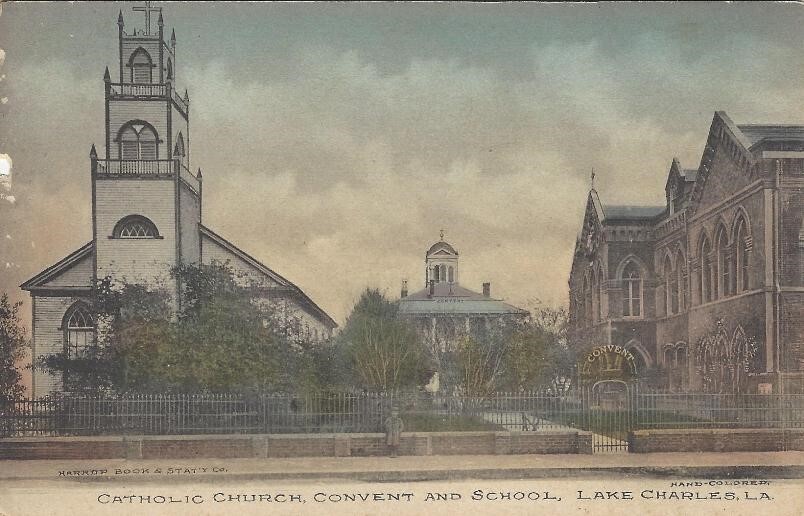
    <summary type="html"><![CDATA[<p><strong><em>Though this church and its associated buildings were destroyed in a catastrophic fire in 1910, it has been rebuilt into something magnificent.</em></strong></p><img src="https://mail.acadianahistorical.org/files/fullsize/5089b5df2b22fdc0feba3e0558a14d74.jpg" alt="Postcard of Immaculate Conception Parish" /><br/><p>In the wake of the Civil War, a 4,000-square-mile parish named St. Francis de Sales formed in western Louisiana (Oubre 40). In 1869, St. Francis de Sales became an established parish by the archbishop; in 1881, the parish constructed a new church and named it the Immaculate Conception (“The Story”). Attached to the parish was St. Charles Academy, which “served as the center of education for Calcasieu Parish” (“Our History”). These structures were lost, however, to a devastating fire in 1910, which consumed 109 buildings in Lake Charles (“The Fire Walk Script”), including “Immaculate Conception Church, its rectory, the boys and girls Catholic schools, and the convent of the Sisters Marianites of Holy Cross” (“The Story”).</p><p>On December 18, 1913, the current Immaculate Conception church was dedicated. This structure was designed by the same architects who designed Calcasieu Marine Bank, Calcasieu Parish Courthouse, and the Strand Theatre, all of which “are listed on U.S. National Park Service’s National Register of Historic Places” (“The Story”). It is interesting to know that, while “buildings owned by religious organizations are typically excluded from being listed in the registry, an exception was made for Immaculate Conception because of [its] great artistic value” (“The Story”). In 1980, Pope John Paul II established the Diocese of Lake Charles, and the church of the Immaculate Conception was elevated to the status of a cathedral. It is a beautiful landmark worthy of this honor.</p><p><em><strong><a href="https://mail.acadianahistorical.org/items/show/57">For more (including 4 images) view the original article</a></strong></em></p>]]></summary>
    <published>2018-04-30T14:23:59+00:00</published>
    <updated>2026-03-04T22:42:47+00:00</updated>
    <link rel="alternate" type="text/html" href="https://mail.acadianahistorical.org/items/show/57"/>
    <id>https://mail.acadianahistorical.org/items/show/57</id>
    <author>
      <name>Briley Higginbotham</name>
    </author>
  </entry>
  <entry>
    <title type="html"><![CDATA[A Survey of Success: The Fenstermaker Story]]></title>
    <summary type="html"><![CDATA[<p><strong><em>C. H. Fenstermaker & Associates, L.L.C., started in the back bedroom of Charles Howard Fenstermaker's family home at 317 Allen Street, New Iberia.</em></strong></p><img src="https://mail.acadianahistorical.org/files/fullsize/c12030ed4886514274c0c6b5a1d64dc7.jpg" alt="Howard Fenstermaker, C.E." /><br/><p>Charles Howard Fenstermaker Jr. studied civil engineering at Louisiana State University from 1934-38. He fought in World War 2 at the Western Front, including the Battle of Anzio, and returned home in 1945. He worked as a surveyor for Texaco before becoming an independent contractor in 1950. In 1951, he was called back into service during the Korean War. </p><p>After returning stateside in 1952, Howard resumed his job as a civil engineer, working from his home at 317 Allen St., New Iberia. The job of a surveyor was a physical one. It required a minimum of three people to make a crew. One crewman cut a line through the swamp or dense forest using a machete. Two men were required to hold two poles with a link of chains 66 ft long stretched between them. Howard used his level - a surveyor's tool with a compass and a level - to calculate the land's bearing, direction, height, and fall using trigonometry. They used USGS monuments as control points, building catalogs of their work. </p><p>Howard would gather his survey crew from a nearby bar at 3:30/4 in the morning. He would collect men who had been at the bar all night or knew to show up early seeking work. It was strenuous work and left the men exposed to the elements. There were snakes, hornets, sun, and humidity; it wasn't uncommon for the men to walk away with snake bites or stings. When they finished surveying for the day, Howard would return to his office and draw the data at his drafting table, often working late into the night to finish the job. He was known for his attention to detail and photographic memory, and his work earned him a reputation for reliability and excellence. </p><p>By 1954, Howard needed more space as his family and business grew, so he moved his office to three rooms in a commercial building at 127 Burke Street, New Iberia. The company moved twice more before settling its headquarters at 135 Regency Square, Lafayette, in the early 80s. In 1971, Howard's oldest son, William Fenstermaker, started working full-time with his father. Nine years later, William took over as C.E.O. and president of Fenstermaker. In 2019, Charles Howard Fenstermaker III, William's son, was named president of the company. The company has remained family-oriented, with three of Howard's sons and several of his grandchildren working for the company. </p><p>Howard Fenstermaker's incredible work drive and belief in development and growth built a company that has lasted nearly 75 years and will undoubtedly continue to grow over the next half-century. Fenstermaker has grown all across the South and it all started in the back bedroom of 317 Allen Street.</p><p><em><strong><a href="https://mail.acadianahistorical.org/items/show/210">For more (including 9 images&#32;&amp;&#32;1 audio file) view the original article</a></strong></em></p>]]></summary>
    <published>2024-03-30T22:57:12+00:00</published>
    <updated>2026-03-04T22:42:49+00:00</updated>
    <link rel="alternate" type="text/html" href="https://mail.acadianahistorical.org/items/show/210"/>
    <id>https://mail.acadianahistorical.org/items/show/210</id>
    <author>
      <name>Marie Hamilton</name>
    </author>
  </entry>
  <entry>
    <title type="html"><![CDATA[A.C. Schiro Memorial Highway : Merryville High School Coach to Sheriff Deputy ]]></title>
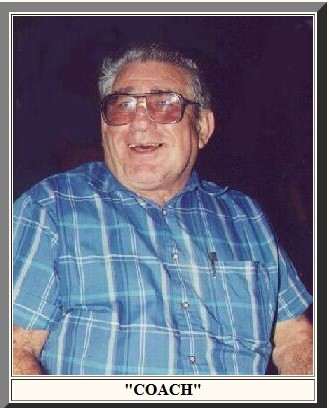
    <summary type="html"><![CDATA[<p><strong><em>A coach is a passionate and dedicated person that encourages and develops a team or player</em></strong></p><img src="https://mail.acadianahistorical.org/files/fullsize/0d4c727757ba39e563a6254e12b8e975.jpg" alt="Coach A.C. Schiro" /><br/><p>Being a high school coach takes commitment and time. People look up to you and will never forget you.</p><p>A.C. “Coach” Schiro was born January 21st 1927 in Baton Rouge, Louisiana. He graduated from Baton Rouge High School and went to college at Louisiana Tech University. He received his masters degree from McNeese State University. He moved to Merryville in 1949 after finishing college and began teaching and coaching at Merryville High School. He retired in 1979 after serving as a teacher, head football coach, and principal.</p><p>As a football coach at Merryville High School, Coach Schiro’s team won the district title twice. His team's first district title was in 1954 and the second was in 1963. His teams were also district runner-up four times. Those years were 1956, 1958, 1959, 1960. The Merryville class of 1954 credits their head coach on their class website. He served as head football coach of the Merryville Panthers from 1949 up until the late 1960's. After coaching, he became the principal of Merryville High School until his retirement in 1979. </p><p>After retirement from the public school system, Coach Schiro became Deputy Schiro for the Beauregard Parish Sheriff’s Office from 1980 to 1997. Even though he was not from the Beauregard area, he was deeply involved with the community. He lived for a few short years after retiring from the Sheriff's Office. He died on March 27th 2001 at the age of 74. </p><p>Shortly after his passing, the Louisiana DOTD dedicated a section of Louisiana Highway 110 in Merryville to A.C. “Coach” Schiro. The section of the road passes in front of Merryville High School and stretches for one mile. For his years of dedication to this small town high school,  Senator James David Cain proposed that the highway should be dedicated to him. It was finally passed and on Monday October 29th 2001, a ceremony was conducted to honor Coach Schiro. Officially naming the highway that passes in front of Merryville High School as “A.C. Schiro Memorial Highway”.</p><p>"I had a foul shot coming and I made that, also. I heard Coach Schiro let out a triumphant yell, because he spent lots of time with me in my basketball training" - George Edward Dewey Merryville Class of 1954.  </p><p><em><strong><a href="https://mail.acadianahistorical.org/items/show/301">For more (including 6 images) view the original article</a></strong></em></p>]]></summary>
    <published>2026-03-10T15:34:38+00:00</published>
    <updated>2026-05-07T23:26:23+00:00</updated>
    <link rel="alternate" type="text/html" href="https://mail.acadianahistorical.org/items/show/301"/>
    <id>https://mail.acadianahistorical.org/items/show/301</id>
    <author>
      <name>Ian Harrington</name>
    </author>
  </entry>
  <entry>
    <title type="html"><![CDATA[A.J. Davis Memorial Highway: A Louisiana Pilot&#039;s Final Flight ]]></title>
    <summary type="html"><![CDATA[<img src="https://mail.acadianahistorical.org/files/fullsize/02a65c721b2e779ef721ee4ff84041fb.jpg" alt="[Untitled]" /><br/><p>In the heart of Louisiana, where old live oaks stretch out over the bayou roads, there's a highway named after a local hero. This man answered his country's call to serve from the cockpit of a military plane. Back in 1997, the Louisiana Legislature decided to honor Captain Ashley James "A.J." Davis by naming the A.J. Davis Memorial Highway after him. Davis was from Baton Rouge and flew for the United States Air Force, sadly losing his life while serving his country.</p><p>A.J. Davis was born on November 19, 1960, in Hammond, Louisiana, a place known for its strong-willed people. He joined the Air Force in 1989 and worked his way up to become an Aircraft Commander in the 76th Airlift Squadron. During his time in the Air Force, he spent over 2,900 hours flying the military CT-43 plane. Davis had many important jobs, including flying First Lady Hillary Clinton to Bosnia and Turkey. He also played a role in Operation Deliberate Force, which took place over Serbia in 1995. His experiences took him to the highest levels of duty, giving him a unique perspective on the world. Davis's time in the Air Force was marked by notable assignments and a strong sense of determination, reflecting the character of his hometown in south Louisiana.</p><p>On a rainy April 3, 1996, Captain Davis was in charge of Flight IFOR 21, which took off from Zagreb. The plane was carrying a very important group of people, including Commerce Secretary Ronald H. Brown, who were on a mission to help rebuild Bosnia and Croatia after the Dayton Accords. As the plane flew through the heavy rain and poor visibility, it relied on old navigation systems to guide it towards Dubrovnik Airport. But something went terribly wrong, and the plane crashed into a mountainside near the city. Sadly, all 35 people on board lost their lives in the tragic accident. The incident was a devastating blow to the efforts to rebuild the war-torn region, and it would be remembered for a long time as a tragic loss of life.</p><p>President Clinton paid his respects to the fallen heroes at Dover Air Force Base, recalling their bravery as patriots who brought America's hope to a far-off and troubled land. Meanwhile, in Mississippi, Captain Davis, who was only 35 years old, was given a final farewell at Biloxi National Cemetery. His life, though short, was one of service and sacrifice, leaving behind a legacy that will be remembered. The president's words echoed the sentiments of a nation, as people came together to mourn the loss of these brave men and women.</p><p>The A.J. Davis Memorial Highway is a lasting tribute that can be found along the roads of his home state, serving as a reminder of a man who came from the bayous of Louisiana and went on to serve with great distinction and courage. This highway stands for all the people from Louisiana who have worn a uniform, whether they were in the air, at sea, or on the battlefield, and unfortunately did not make it back home. As people drive by the moss-covered oak trees, they are reminded of his name, which lives on as a son of Louisiana who will never be forgotten. The memorial highway is a quiet way to honor his memory, and it's a testament to the impact he had on the state and its people. For those who travel through the area, the highway is a poignant reminder of the sacrifices made by people like A.J. Davis, and it's a way to keep his legacy alive.</p><p>Drive slow. Look up. And carry his spirit forward. </p><p><em><strong><a href="https://mail.acadianahistorical.org/items/show/335">For more (including 3 images) view the original article</a></strong></em></p>]]></summary>
    <published>2026-05-08T03:43:41+00:00</published>
    <updated>2026-05-08T17:25:16+00:00</updated>
    <link rel="alternate" type="text/html" href="https://mail.acadianahistorical.org/items/show/335"/>
    <id>https://mail.acadianahistorical.org/items/show/335</id>
    <author>
      <name>Acadiana Historical</name>
    </author>
  </entry>
  <entry>
    <title type="html"><![CDATA[Abbey Players Play On Your Heartstrings: Abbey Players PLAYED their Part]]></title>
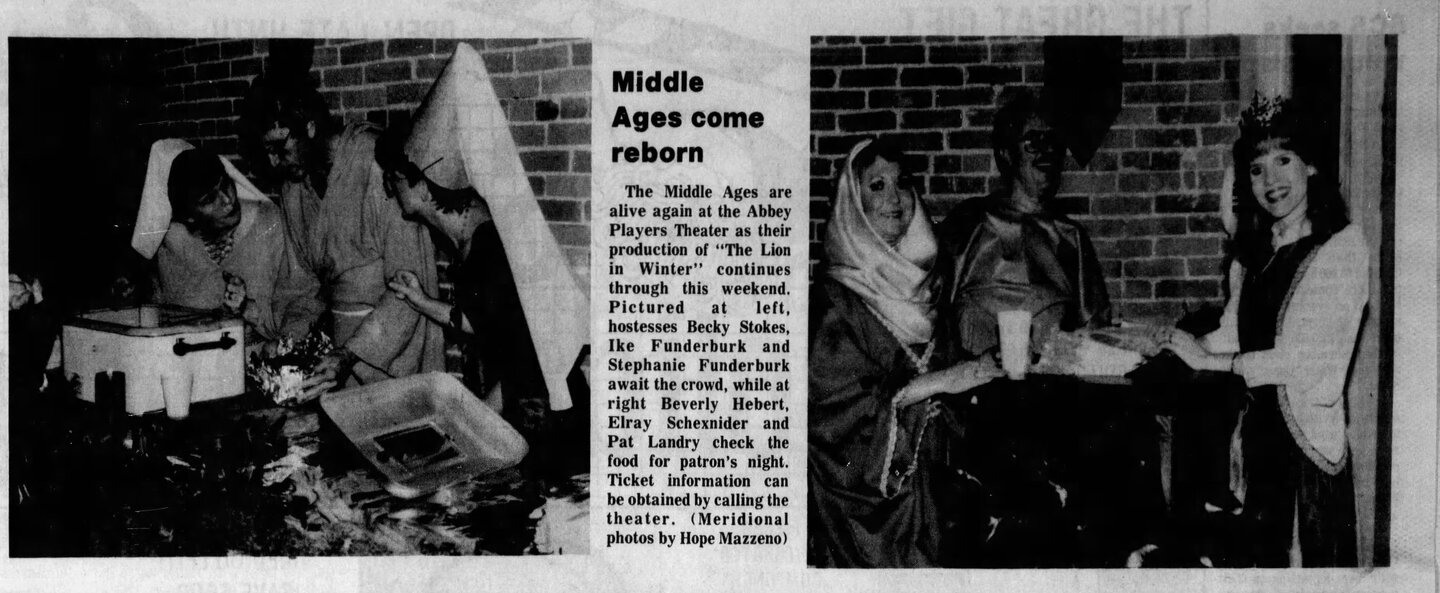
    <summary type="html"><![CDATA[<p><strong><em>A story about creatives who had very little funds yet still provided a performing arts community in Abbeville with a small secret for their theater.</em></strong></p><img src="https://mail.acadianahistorical.org/files/fullsize/ca01392eaea93f556e0ded3015291a5b.jpg" alt="Abbeville Meridional newspaper clipping (15 Dec 1983)" /><br/><p>Can a group of talented friends provide entertainment to the community? The story of the Abbey Players Theater begins with their first actors highly interested in the performing arts and so Ted and Lynette Winter Cessac and their partner, Dave Pierce formed the Abbey Players. The Abbey Players themselves were a non-profit acting group in 1976 moving around town in Abbeville performing plays like a standard troupe. Their local newspaper captured the heart of their performances and the Abbeville crowd loved the well-done performances each time. It showed how a ragtag team of performers could start something by continuing to practice small plays over and over. </p><p>The group rented many locations but they desired a stable venue rather than schools, banks, and small stages. </p><p>They featured in many instances for their local newspaper for outstanding performances and eventually placed an advertisement in November of 1980 for a more permanent location. They settled on a lumber mill, the Reaux Lumber Co., which was a saloom in the early 1900s and their public stage was set as they continued to perform for the city. They completely renovated the old warehouse with a stage, backstage, and fitting room as well as installing lights fixtures for their upcoming plays of “the Rainmaker”, “Cat on a Hot Tin Room”, and “The Man who Came to Dinner”. </p><p>The theater served hors d'oeuvres and champagne which became such a regular occurrence that it was cemented into their calling card as Patrons’ Night. The waiting area has multiple chairs and tables for a comfortable night out with friends to catch a lovely play. A little known fact about their current location is supposedly haunted and paranormal investigators visited the location where their investigation yielded sounds from a little ghost girl.</p><p><em><strong><a href="https://mail.acadianahistorical.org/items/show/109">For more (including 13 images&#32;&amp;&#32;1 audio file) view the original article</a></strong></em></p>]]></summary>
    <published>2022-03-03T22:35:11+00:00</published>
    <updated>2026-03-04T22:42:47+00:00</updated>
    <link rel="alternate" type="text/html" href="https://mail.acadianahistorical.org/items/show/109"/>
    <id>https://mail.acadianahistorical.org/items/show/109</id>
    <author>
      <name>Thanh Vo</name>
    </author>
  </entry>
  <entry>
    <title type="html"><![CDATA[Against The Grain: The Endurance Of The Conrad Rice Mill: The 112-year-old Conrad Rice Mill is the oldest operating rice mill in America. ]]></title>
    <summary type="html"><![CDATA[<p><strong><em>The Conrad Rice Mill is a story of success and resilience, steered by competent and astute businessmen from Philip Conrad to Mike Davis.</em></strong></p><img src="https://mail.acadianahistorical.org/files/fullsize/a12caeca25911578813211e87fd4bf1f.jpg" alt="Conrad Rice Mill When Purchased" /><br/><p>Philip Amalus Conrad, a true entrepreneur, founded the Conrad Rice Mill and Planting Company in 1912. Following in his father's footsteps as a rice planter, Philip saw an opportunity for growth. Instead of shipping his rice to New Orleans, a risky and time-consuming process, he decided to establish a mill on his property in New Iberia. As the company flourished, the mill began sourcing grain from other rice growers to meet consumer demand. </p><p>At the age of retirement, Philip passed on his hard work to his three sons. The brothers branded the company KONRIKO as an acronym for Conrad Rice Company in the 1950s. In 1975, Mike Davis bought the mill and brought it back to life after it had been dormant for two years. Davis was a schoolteacher for St. Martin and Iberia Parishes. One of the biggest obstacles for Davis was having to learn how to produce rice. He had to analyze why the mill had been sitting dormant and needed to execute a plan to get it running again. He also had to figure out how to pack the milled rice; after packaging the rice, he went store to the store to ask them to sell the product. </p><p>When Davis took over the mill, they started by simply selling white rice, but as time moved on, he transitioned the mill to creating specialty rice. KONRIKO also expanded into selling cooking mixes and seasonings: Greek, Creole, jalapeno, etc. The brand also created a gravy thickener using rice starch instead of corn starch. KONRIKO's signature product is wild pecan rice; it was the first product Davis released about two years after purchasing the mill. </p><p>In the 1980s, Davis applied to the National Historical Register. It helped to create a tourist attraction. Now, the Conrad Rice Mill is a must-see in New Iberia, although ironically, half of the city has yet to see it. Roughly 50,000 people visit the mill annually. Davis also built a general store in 1981. It is modeled after a plantation company store. KONRIKO offers tours of the mill and a slide show presentation. In total, KONRIKO covers about 5 – 6 acres in New Iberia. The oldest building was built in 1912, and the newest building, a warehouse, was built by Davis in the late 1980s and early '90s.</p><p>Today, the Conrad Rice Mill continues to thrive, producing rice and rice-based products nationwide. This is a testament to the ingenuity and perseverance of those who have worked to keep the mill running for over a century.</p><p><em><strong><a href="https://mail.acadianahistorical.org/items/show/230">For more (including 19 images&#32;&amp;&#32;1 audio file) view the original article</a></strong></em></p>]]></summary>
    <published>2024-04-19T03:09:37+00:00</published>
    <updated>2026-03-04T22:42:50+00:00</updated>
    <link rel="alternate" type="text/html" href="https://mail.acadianahistorical.org/items/show/230"/>
    <id>https://mail.acadianahistorical.org/items/show/230</id>
    <author>
      <name>Marie Hamilton</name>
    </author>
  </entry>
  <entry>
    <title type="html"><![CDATA[Aisne-Marne Cemetery and Memorial:  &quot;I never saw men charge to their death with finer spirit.&quot; ~Floyd Gibbons]]></title>
    <summary type="html"><![CDATA[<p><strong><em>A serene cemetery dotted with white crosses and Stars of David and a white chapel commemorate the loss of American soldiers who fell during the Aisne-Marne operation. </em></strong></p><img src="https://mail.acadianahistorical.org/files/fullsize/45d615fa16854ede4162d534c6d0483f.jpg" alt="Aisne-Marne American Cemetery: Site Overview" /><br/><p>The Second Battle of the Marne had incredibly high casualties with over 272,000 casualties within the space of three full days. Of these, only 12,000 were Americans who fell in battle. It is no surprise then that many of these men hailed from Acadiana. These men include: Horace Aucoin (Chataignier), Louis Bellard (Crowley), Joseph R. Businick (Lake Charles), John F. Clark (New Iberia), Murphy J. Cole (DeRidder), Henry H. Dalrymple (Midway), Claymile J. Darcy (Gray), Merritt B. Durham (Baton Rouge), Joseph C. Gaudin (Donaldsonville), Nick Gonzales (New Roads), Joseph A. Gregoire (Franklin), Cleopha P. Hebert (Cameron), Theodore Jacquet (New Iberia), Arthur Kennedy (Plaquimine), Adrien Kilbert (Convent), Sidney Manuel (Mamou), Laurence Miller (Plaquimine), Dorsle Richard (Cameron), and Isaac C. Savoie (Houma). </p><p>Isaac C. Savoie was 25 when he enlisted in the Army and served as an infantryman in both the 347th Infantry and the 23rd infantry, with which he was serving in Company E when he fell during the Second Battle of the Marne.</p><p>In the quiet French countryside, a sweeping cemetery speckled with white crosses and Stars of David now resides in silence on what was once one of the worst battlefields the world had ever seen. The Aisne-Marne Cemetery is the final resting place for almost 2,300 American soldiers. The 42.5 acre cemetery was designed and dedicated by the American Battle Monument Commission in 1937, and is located near the base of Belleau Wood. The cemetery is divided into two plots with the memorial chapel situated between them, each plot consisting of thirteen rows of graves. Of the 2,289 soldiers buried in these plots 250 remain unidentified.  </p><p>The Monument Chapel: Sitting where the front line had been dug, now between burial plots is a white Gothic Revival chapel with a distinguished bell tower that watches over the battlefield turned cemetery. The chapel is adorned with stain glass that features insignia of the Allied Forces and equipment, and provides a quiet space for reflection. Inscribed into the stone walls in large letters is: “THE NAMES RECORDED ON THESE WALLS ARE THOSE OF AMERICAN SOLDIERS WHO FOUGHT IN THIS REGION AND WHO SLEEP IN UNKNOWN GRAVES.” Beneath this salutation are 1,060 names of those who went missing during the various battles in this region. Some are accompanied by rosettes, indicating that the missing soldier had been found and identified. These names include a few Acadiana men. During the Second World War the cemetery and chapel came under fire and was damaged by heavy artillery. During post-war years the chapel was repaired, but the architect chose to leave one bullet hole near the entrance as a reminder of the fighting that took place in this region. </p><p>In an effort to distract Allied troops from their planned attack on Flanders, the Germans launched their last major offensive on the Marne. Beginning on 15 July, 1918 when German divisions attacked the French Army to the east and west of Reims. In the east, though the French artillery were reduced in number, they began an assault prior to the Germans planned bombardment, taking them by surprise. By the time the Germans had time to retaliate, the French lines were almost completely empty. Following the trenches the Germans found the bulk of the French army and, as they found out when they attacked the next morning, the bulk of French artillery. The attack to the west was much more successful beginning with a three hour bombardment which left the Allied forces scarce, until 17 July, when the British Expeditionary Force and 85,000 troops of the American Expeditionary Force came to reinforce the survivors. On 18 July, the Allied counterattack began when twenty-four French divisions, eight large American divisions, along with other Allied divisions attacked the enemy lines. Allied intelligence knew what the Germans plan of attack minute by minute, partially because the Americans fed the enemy false plans, and were able to deceive them. Allied troops attacked the exposed parts of enemy lines leaving them no choice but to retreat. On 20 July, German leadership ordered a retreat back to where their Spring Offensive had begun.  </p><p>The Second Battle of the Marne is considered to be the turning point in the war, which alerted German leadership to the idea that they would lose the war. Allied forces had captured 29,367 German troops and caused 168,000 casualties.</p><p><em><strong><a href="https://mail.acadianahistorical.org/items/show/162">For more (including 10 images&#32;&amp;&#32;1 audio file) view the original article</a></strong></em></p>]]></summary>
    <published>2022-04-28T18:55:09+00:00</published>
    <updated>2026-03-04T22:42:48+00:00</updated>
    <link rel="alternate" type="text/html" href="https://mail.acadianahistorical.org/items/show/162"/>
    <id>https://mail.acadianahistorical.org/items/show/162</id>
    <author>
      <name>Theresa Slovacek-Herrera</name>
    </author>
  </entry>
  <entry>
    <title type="html"><![CDATA[All Aboard the Orphan Train!: The History of Opelousas&#039; Orphan Train Movement]]></title>
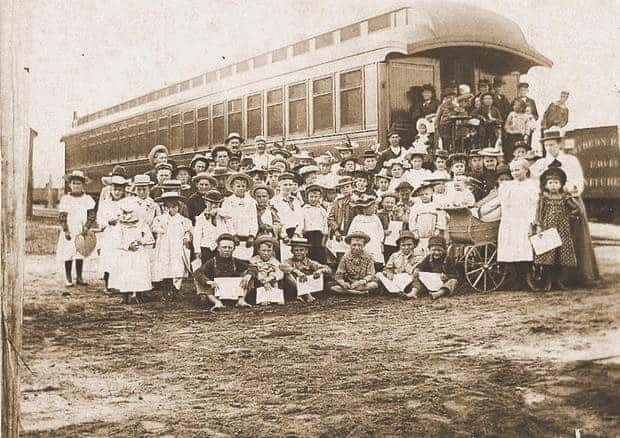
    <summary type="html"><![CDATA[<p><strong><em>Next stop--Opelousas!</em></strong></p><img src="https://mail.acadianahistorical.org/files/fullsize/d6bac398019135f034985388d0879795.jpg" alt="Orphaned Children in Front of One of the Train Cars of the Orphan Train" /><br/><p>During the late eighteenth and early nineteenth century, there was a crisis in New York City with mothers abandoning their infants in front of orphanages due to the poor welfare institutions present. The Sisters of St. Peter’s Convent in New York would install an asylum to care for the orphans left at their convent. However, the orphanages across the city were running out of room and had to find a way to find people willing to adopt the orphans. Charles Loring Brace began the orphan train movement to transport children to parents in far regions as a way to find people who were willing to adopt the orphans. However, since the movement was under the guidance of the Sisters, the orphan train movement believed Catholic parents should rear the children. One location the Sisters believed to be a good place for a Catholic upbringing was the southwestern section of Louisiana; so, an orphan train station opened in Opelousas.</p><p>Rev. John Engberink of St. Landry Catholic Church was able to provide parents to the orphans arriving in Opelousas. However, there was a problem with the language barrier between the English-speaking orphans and the French-speaking foster parents, and many of the foster parents did not tell their adopted children about the orphan train in Opelousas. The descendants of the orphans were the ones to tell the story of the orphan train’s presence in the city of Opelousas. Nevertheless, the changing social and welfare conditions in New York brought an end to the orphan train movement in 1927.</p><p><em><strong><a href="https://mail.acadianahistorical.org/items/show/135">For more (including 5 images&#32;&amp;&#32;1 audio file) view the original article</a></strong></em></p>]]></summary>
    <published>2022-03-23T09:39:47+00:00</published>
    <updated>2026-03-04T22:42:47+00:00</updated>
    <link rel="alternate" type="text/html" href="https://mail.acadianahistorical.org/items/show/135"/>
    <id>https://mail.acadianahistorical.org/items/show/135</id>
    <author>
      <name>Matthew D. Mayer</name>
    </author>
  </entry>
  <entry>
    <title type="html"><![CDATA[Allons Chez Tee Maurice: Tee Maurice Race Track and Dance Hall, 1902-1983: Furlongs and Fais Do Dos ]]></title>
    <summary type="html"><![CDATA[<p><strong><em>The rhythmic sound of hooves flying across the dirt. The cheers of racegoers. The melody of a fiddle and accordion lingering in the evening air. Feet shuffling to a two-step or Cajun waltz. The voices of families happily greeting their friends and neighbors. These were the sounds of the weekend at Tee Maurice.</em></strong></p><img src="https://mail.acadianahistorical.org/files/fullsize/6c4f064fe9dc8c0deaa48877f92d7b87.jpg" alt="It Once was a Dance Hall" /><br/><p>The Richard family possesses a sort of dynastic quality in the world of Cajun bush tracks. Maurice Richard and his wife, Celestine, bought the property in 1902 in present-day Church Point, an area once known locally as <i>Marais des Buller</i>.</p><p>The Richard family's involvement with horse racing goes back to the early nineteenth century. A sharecropper by trade, Maurice loved racing his horses against those of his neighbors. He considered opening an unsanctioned quarter horse track, but with eleven children, life was hectic, and he needed the land to grow crops. However, as the great New York Yankee legend Yogi Berra once said, “When you get to a fork in the road, take it.” That is exactly what Maurice did. Choosing both routes, he divided his time—and land— between the farm and the track, which he aptly named Tee Maurice. Tee Maurice grew to be a bastion of quarter horse racing in Acadiana and a major entertainment hotspot. </p><p>In the 1930s, Maurice’s son Ellis opened a dance hall that the locals named “Richard’s Casino.” Food and music became an inseparable part of the landscape. Renowned musicians such as Happy Fats, Johnnie Allan, and Blackie Forestier played at the dance hall at Tee Maurice. One night could see as many as 700 people waltzing to the music of “Doc” Guidry. </p><p>In addition to the original ten arpent straight quarter horse track, the Richards eventually built a one-half-mile thoroughbred track behind the dance hall. A stock car track was later added. Tee Maurice became known as the grandest and most renowned bush track in the area, with the ability to attract thousands of visitors in one weekend. </p><p>The family owned several trucks and would drive to Opelousas, Lewisburg, Lawtell, Sunset, and Carencro to pick racegoers up and bring them to watch the races and dance. Others would walk or arrive in their wagons. Tee Maurice and Richard's Club closed in 1983 when Ellis Richard passed away. </p><p>A visit to the property to speak to Ellis’ son, Winston, daughter-in-law, Kathy, and daughter, Guinn, was an enjoyable experience. They knew the stories well. They sat around the kitchen table, reliving the glory days of Tee Maurice. The track and dance hall are as much a part of them as the family who came before them. They remembered people who are long gone, and exchanged stories with each other as if they were trading baseball cards. </p><p>A stroll around the property was meaningful. I saw the old dance hall, which Winston converted into a barn for his horses. Walking into the shaded entrance on that bright April afternoon, I could not help feeling the excitement of a new day meeting old history. Mrs. Kathy must have been thinking the same thing. “I wonder how many feet danced right here,” she thought aloud. </p><p>120 years have come and gone since the first horses stepped onto the track at Tee Maurice. A slab foundation at the road serves as proof that a dance hall once existed. The dance hall is now a barn for the Richard’s horses. Its walls, which recently sustained hurricane damage, are a memorial to our ancestors who contributed so greatly to the music and horse culture of Cajun country— A perfect example of how the landscape is always changing and of how we live alongside our history. </p><p><em><strong><a href="https://mail.acadianahistorical.org/items/show/181">For more (including 20 images) view the original article</a></strong></em></p>]]></summary>
    <published>2022-05-08T23:36:06+00:00</published>
    <updated>2026-03-04T22:42:48+00:00</updated>
    <link rel="alternate" type="text/html" href="https://mail.acadianahistorical.org/items/show/181"/>
    <id>https://mail.acadianahistorical.org/items/show/181</id>
    <author>
      <name>Laura M. Hughes</name>
    </author>
  </entry>
  <entry>
    <title type="html"><![CDATA[Ambassador Caffery Parkway]]></title>
    <summary type="html"><![CDATA[<p><strong><em>Caffery was well known for the many different assignments he had completed. </em></strong></p><img src="https://mail.acadianahistorical.org/files/fullsize/02869423414ca61123bb46bbf71cddfb.jpg" alt="[Untitled]" /><br/><p>Ambassador Caffery Boulevard was named in honor after an important man Jefferson Caffery.  Caffery was born in Lafayette, Louisiana in 1886. He went to The Southwestern Industrial Institute which is now known as The University of Louisiana at Lafayette. After attending The Southwestern Industrial Institute in 1906, he graduated from Tulane University in New Orleans, Louisiana. Caffery had many different assignments but there were five major ones that he was widely known for. In1926 he was promoted to El Salvador, then went to Cuba. He was then sent to Brazil to keep the country neutral during WW2 in 1937. Then in 1944 Caffery</p><p>was appointed Ambassador of France during the time when the government was being reestablished. Finally, in 1955 he was awarded The Cordon of Republic in Egypt. After his final destination in Egypt Caffery and his wife retired in Rome, Italy. There he was the honorary private chamberlain to three popes, Pius XII, John XXIII, and Paul VI. Shortly after the death of Mrs. Caffery he then returned back to Lafayette, Louisiana in 1973. Both Mr. and Mrs. Caffery are buried behind the St John’s Cathedral in Lafayette. The street Ambassador Caffery Parkway is named in his honor. </p><p><em><strong><a href="https://mail.acadianahistorical.org/items/show/70">For more view the original article</a></strong></em></p>]]></summary>
    <published>2018-05-03T15:55:23+00:00</published>
    <updated>2026-03-04T22:42:47+00:00</updated>
    <link rel="alternate" type="text/html" href="https://mail.acadianahistorical.org/items/show/70"/>
    <id>https://mail.acadianahistorical.org/items/show/70</id>
    <author>
      <name>Hannah Bryan</name>
    </author>
  </entry>
  <entry>
    <title type="html"><![CDATA[An Acadian Home: St. Martin de Tours Catholic Church ]]></title>
    <summary type="html"><![CDATA[<p><strong><em>Learn about the unique church right on the Bayou Teche! </em></strong></p><img src="https://mail.acadianahistorical.org/files/fullsize/e1003794e8a8f82d77bc2fe91eebfc7e.jpg" alt="St. Martin de Tours " /><br/><p>Saint Martin de Tours Catholic Church was founded by the Acadian exiles in 1765 when they arrived in St. Martinville. This church was officially blessed as a new church in the Archdiocese of New Orleans. The number of parishioners that this church had, became too overwhelming for the small church to handle. There was a petition to start building a bigger church and it was granted in 1820, two years after the Diocese of Lafayette was formed. This new church was not finished until 1844 but they finally had enough space for all of the parishioners. </p><p>If you go inside the church you see many beautiful aspects that you would not normally see in churches anymore. The raised pulpit was one of the unique characteristics that brought people to the church. Priests used raised pulpits back in the day so the congregation could hear the readings and homily. It ensured that the priest’s voice would carry over the crowd to the back of the church. We have to remember that this was a time before technology like microphones was even in somebody’s thought process. The pulpit is still used today because they want to keep their history alive. 200 years after the church was created, St. Martin de Tours had its first American-born priest, Fr. Kenneth R. Morvant. He was also the first priest of Acadian descent. Every priest after him has been of Acadian descent and that has helped keep the culture alive (More of Our Church History). </p><p><em><strong><a href="https://mail.acadianahistorical.org/items/show/46">For more (including 3 images&#32;&amp;&#32;1 audio file) view the original article</a></strong></em></p>]]></summary>
    <published>2018-04-26T15:45:38+00:00</published>
    <updated>2026-03-04T22:42:46+00:00</updated>
    <link rel="alternate" type="text/html" href="https://mail.acadianahistorical.org/items/show/46"/>
    <id>https://mail.acadianahistorical.org/items/show/46</id>
    <author>
      <name>Sophia Verret</name>
    </author>
  </entry>
  <entry>
    <title type="html"><![CDATA[An American Actor&#039;s Dream Plantation : From Bob Acres Plantation to Rip Van Winkle House and Gardens ]]></title>
    <summary type="html"><![CDATA[<img src="https://mail.acadianahistorical.org/files/fullsize/cd4d5f88835f03fc9ee7444c0a47b5af.jpg" alt="Joseph Jefferson House " /><br/><p>In 1869, American actor Joseph Jefferson purchased “Orange Island,” as it was known at the time of the purchase, which sat atop a salt dome on Lake Peigneur to use as his winter home and hunting lodge. The “island,” referred to now as Jefferson Island, is not actually an island at all; instead, it is a piece of land formed that sits atop the salt dome. It is one of four salt dome islands in Acadiana, along with Avery Island, Weeks Island, and Cote Blanche.</p><p>Jefferson built what he referred to as the Rip Van Winkle House in 1870. He had played the role of Rip Van Winkle in a film adaptation of Washington Irving’s short story by the same name of "Rip Van Winkle;" because of his love for the dramatic arts, he named his beloved plantation home after it. The plantation, which Jefferson called the Bob Acres Plantation after a character from another play that he acted in, "The Revivals," was made up of approximately 3,600 acres. The jewel of the property, the Rip Van Winkle House, was built using cypress wood that was grown in New Iberia, the location of the plantation. </p><p>Although plantations of this time were often used as farms for agriculture, Jefferson was not a farmer and did not use his plantation for commerce. Instead, he would host extravagant parties at his beloved Bob Acres Plantation, that included guests such as President Grover Cleveland, who is said to have enjoyed taking naps under the enormous oak trees dotting the plantation. </p><p>Joseph Jefferson died in 1905 leaving the Bob Acres Plantation to his heirs. In 1917, the heirs to the plantation sold Jefferson Island and the plantation to John Lyle Bayless, Sr. of Anchorage, Kentucky; Paul Jones, bourbon distiller of Louisville, Kentucky; and E. A. McIlhenny of Avery Island, Louisiana. Son of John Lyle Bayless, Senior, Bayless, Junior, developed gardens around the home in 1950 in honor of Joseph Jefferson, affectionately calling them the Rip Van Winkle Gardens. Bayless sold the salt mines that ran underneath the lake and property and donated the Joseph Jefferson House and 800 acres of gardens to a foundation that would ensure that the grounds would be maintained long after he died. </p><p>On November 20, 1980, a Texaco drilling rig pierced one of the giant salt caverns and flooded the entire salt mine. This caused four years of damage to the property, creating a vortex that  formed in the lake which swallowed a glass conservatory and garden that Bayless had built, Bayless’s retirement home, the Rip Van Winkle Welcome Center and 65 acres of native woodland. However, four years after this incident, Rip Van Winkle Gardens were up and running again and today are the location of many weddings, private events, tours, and an on site bed and breakfast. </p><p><em><strong><a href="https://mail.acadianahistorical.org/items/show/144">For more (including 5 images&#32;&amp;&#32;1 audio file) view the original article</a></strong></em></p>]]></summary>
    <published>2022-03-31T23:19:07+00:00</published>
    <updated>2026-03-04T22:42:48+00:00</updated>
    <link rel="alternate" type="text/html" href="https://mail.acadianahistorical.org/items/show/144"/>
    <id>https://mail.acadianahistorical.org/items/show/144</id>
    <author>
      <name>Anne-Marie Stokes</name>
    </author>
  </entry>
  <entry>
    <title type="html"><![CDATA[An Influential Politician: Jean Noel Destrehan]]></title>
    <summary type="html"><![CDATA[<p><strong><em>A prominent Louisiana politician and legislator, as well as a mercantilist and planter.</em></strong></p><img src="https://mail.acadianahistorical.org/files/fullsize/cc4e7de1b51d3aab10d7588e2ec85a5c.jpg" alt="[Untitled]" /><br/><p>Jean Noel Destrehan was born in 1754 in what is today St. Charles Parish. He was the son of Jean Baptiste Honore Destrehan de Beaupre, “the head of the Destrehan family line in Louisiana,” the Treasurer of the Louisiana Colony of France (Harvey 13). Jean Noel was educated in France. </p><p>Jean Noel Destrehan married Marie Claude Celeste de Logny. His wife’s father, Antoine Robin de Logny, built for them the Destrehan Manor House in 1787, which is still in St. Charles Parish. Later, the couple had two more wings added to the original house to accomodate their total of fourteen children. </p><p>Destrehan was a prominent Louisiana politician and legislator, as well as a mercantilist and planter. He was a member of the Louisiana Territorial government from 1803 to 1812. At one point, he and two other members carried a petition to the United States Congress to protest a 6% tax duty put on the Louisiana Territory and that the appointed governor could not speak any French. Destrehan was elected the first Vice-Mayor of New Orleans in 1805, and was a member of the legislative council of the Territory of Orleans from 1806 to 1811. In 1812 he was elected as a United States Senator, just after Louisiana became a state. However, he resigned less than a month after his election before even qualifying for office, possibly because he did not speak much English. Destrehan served as a Louisiana State Senator from 1812 to 1818. During this time, he helped to draft the Louisiana Constitution.</p><p>Jean Noel Destrehan de Beaupre died in 1823 and is interred near Destrehan, Louisiana. The street that bears his family name today runs from River Road on the eastbank of the Mississippi to Noel Street in the town named after him.</p><p><em><strong><a href="https://mail.acadianahistorical.org/items/show/32">For more (including 2 images&#32;&amp;&#32;1 audio file) view the original article</a></strong></em></p>]]></summary>
    <published>2018-04-26T15:22:48+00:00</published>
    <updated>2026-03-04T22:42:46+00:00</updated>
    <link rel="alternate" type="text/html" href="https://mail.acadianahistorical.org/items/show/32"/>
    <id>https://mail.acadianahistorical.org/items/show/32</id>
    <author>
      <name>Bailey Lemoine</name>
    </author>
  </entry>
  <entry>
    <title type="html"><![CDATA[An Old Plantation Meant for a Queen <br />
: From Rose Hill Plantation to Queen&#039;s Ranch ]]></title>
    <summary type="html"><![CDATA[<p><strong><em>From an antebellum plantation in the mid nineteenth century to a small family farm in the early twenty-first century, the old Rose Hill Plantation in now the beautiful Queen's Ranch. </em></strong></p><img src="https://mail.acadianahistorical.org/files/fullsize/9d0129ad7c5eb5560609406ac62a93b2.jpg" alt="Run Down Pieces of the Old Sugar Mill " /><br/><p>In 1833 in Vermillion Parish Louisiana, four miles outside of current day Abbeville, LA, War of 1812 veterans, Thomas Fletcher and Brandon McDermott were given 1,000 acres of conjoined land for their help in defeating the British at the Battle of New Orleans. They named this piece of land the Rose Hill Plantation, which, according to Loraine Sirmon, former owner of Queen’s Ranch – the name given to the ranch that Rose Hill Plantation would later become – was named after the Cherokee rose, a thorny rose bush that once surrounded the land. Originally a cotton mill, Rose Hill became a sugar plantation after J. Henry Putnam, a distant relative of famous Salem witch trials witness Ann Putnam, bought the plantation in 1871 with the hopes of becoming a sugar producer. Unfortunately for the Putnam family, a fire on the plantation on December 10, 1881, halted work towards Putnam’s sugar plantation dream after burning down the sugar house and entire crop of sugar. However, only six months later, in May 1882, Putnam was working towards rebuilding his plantation. On November 6, 1882, the Abbeville Meridional reported that J. Henry Putnam’s Rose Hill was working splendidly, grinding cane grown on the property, as well as purchasing cane for four dollars a ton from neighboring farmers.</p><p>In January 1883, the Abbeville Meridional reported that J. Henry Putnam’s Rose Hill Plantation had processed the largest crop ever made in Vermillion Parish. By 1893, the Daily Picayune reported that the plant had processed four million pounds of sugar from the 1892 crop and Putnam planned to produce ten million pounds of sugar per year by 1896. Unfortunately for the Rose Hill Plantation, a tariff put on imported Cuban sugar was lifted. In 1899, it was cheaper to buy imported sugar than it was to grow it and Rose Hill Planting and Refinery Co. Inc. went bankrupt. In 1901, Putnam handed over the deed to the property to the New Orleans banks, which took it over and put a railroad on the property. This railroad ran until about the early 1930s and today is not usable. </p><p>Between the city of New Orleans owning the plantation for the railroad and it eventually becoming Queen’s Ranch, little is known about the ownership of the land. After going through different ownership, Revis Sirmon and his wife, Lorraine Sirmon, purchased Rose Hill Plantation from Mack Schriever in the late 1950s and turned it into a working ranch and farm called Queen’s Ranch. Sirmon, being the jokester that he was, decided on the name “Queen’s Ranch” after his friend, Silas Cooper of Abbeville jokingly mentioned that Texas had the famous and massive King’s Ranch so Louisiana would now have its own Queen’s Ranch. Sirmon was a pilot in World War II and even installed a family museum on the property to showcase paraphernalia from the war along with antique farming equipment used to run the ranch. In the farm’s heyday, it boasted forty-two acres of property and was home to cattle, horses, ducks, quails and even some of the farm hands. In 2018 after the death of Revis Sirmon’s son, and heir to the ranch, Johnny Sirmon, the property was split amongst Revis Sirmon’s two grandsons, Patrick and Dannon Stokes, who still look after the farm today. Today, with more property later bought to add to the farm, Queen’s Ranch is an active cattle farm as well as an active crawfish farm with two hundred-thirty-seven acres making up the property. On the property, there still stands the remains of the old sugar processing plant from Rose Hill Plantation. Although it is no longer in use, lying on the banks of the Vermillion River, the ruins of the plant are beautiful, being overlooked by Louisiana moss and towering oak trees on the property. </p><p><em><strong><a href="https://mail.acadianahistorical.org/items/show/81">For more (including 9 images&#32;&amp;&#32;1 audio file) view the original article</a></strong></em></p>]]></summary>
    <published>2022-02-18T01:30:29+00:00</published>
    <updated>2026-03-04T22:42:47+00:00</updated>
    <link rel="alternate" type="text/html" href="https://mail.acadianahistorical.org/items/show/81"/>
    <id>https://mail.acadianahistorical.org/items/show/81</id>
    <author>
      <name>Anne-Marie Stokes</name>
    </author>
  </entry>
  <entry>
    <title type="html"><![CDATA[Battle of Bayou Bourbaux: Also Called the Battle of Bayou Carencro]]></title>
    <summary type="html"><![CDATA[<img src="https://mail.acadianahistorical.org/files/fullsize/37975f162aeff4e2099fd0fa7a80e3ef.jpg" alt="[Untitled]" /><br/><p>The Battle of Bayou Bourbeux.</p><p>The Civil War was entering its third year, Vicksburg had fallen, and the Union had control of the Mississippi. Gettysburg would produce the most significant loss of life on American soil, with 51,000 casualties. Lincoln would give his Gettysburg address to a hushed crowd, and Louisiana's battle would be pushed to the back pages of History, rememberd only on small historic markers along its country highways. </p><p>General Taylors Army was well versed in the art of war. Having fought in Berwick and retreating north, he would fight At Ft. Bisland, then Franklin and Bayou Teche. From there, it was Vermillionville, then Bayou Bourbeux.</p><p>The 6000 confederate soldiers under General Taylor and led by General Thomas Green would meet in battle at Carencro with 1625  Union troops Led by  General Stephen Burbridge. The Battle of Bayou Bourbeux or Bayou Carencro would leave forty to sixty confederates lost and about three hundred wounded. The Union had lost thirty killed and 129 wounded, and 562 captured. </p><p>Among the confederate fallen Third Sergeant George Speagle, the brother of Philip, who missed that fight due to malaria, and Henry, who had fallen in Kentucky at the age of 17. George would be interned in a mass grave that is now marked by a Historical Marker. Not far from that gave is another on what was the Bellevue Plantation home of Benjamin Rogers. Rogers's home was torn down to harvest the cypress lumber. A new house was built close by, and its slab was poured over the graves of the fallen Yankees.</p><p>The war would continue for another year, continuing to the north, leaving a path of destruction in Opelousas, Alexandria, and Monroe. Not until April 8, 1865, would the killing be done.</p><p><em><strong><a href="https://mail.acadianahistorical.org/items/show/132">For more (including 5 images&#32;&amp;&#32;1 audio file) view the original article</a></strong></em></p>]]></summary>
    <published>2022-03-20T21:08:09+00:00</published>
    <updated>2026-03-04T22:42:47+00:00</updated>
    <link rel="alternate" type="text/html" href="https://mail.acadianahistorical.org/items/show/132"/>
    <id>https://mail.acadianahistorical.org/items/show/132</id>
    <author>
      <name>Gordon Eatley</name>
    </author>
  </entry>
  <entry>
    <title type="html"><![CDATA[Battle of Bisland]]></title>
    <summary type="html"><![CDATA[<p><strong><em>The Battle of Bisland</p><p>It is 1860, and Abraham Lincoln was Just elected, the first Republican to win the White House. The Southern States had threatened secession if the Republicans won, and by the time Lincoln was inaugurated on March 4, 1861, seven states had left the union.  </p><p>A powder keg waiting for something to light its fuse. On April 12, 1861, that fuse was lit as Union ships attempted to resupply Fort Sumter, and South Carolina artillery pounded the redoubt. Others say a battery on Morris Island manned by Citadel Academy cadets fired what is considered to be the first shots of the American Civil War on January 9, 1861, on the U.S. steamer Star of the West trying to reach Fort Sumter. No matter the date, the country was plunged into war , with family and friends caught in the middle.  brother against brother, father against son, The media of the day reported the great battle in Gettysburg, Manasses, or as some called it, Bull run, but Louisana was not spared the suffering of that war  leaving scars that still have not healed.</p><p>In 1864 saw, the Union Army deep within the south. New Orleans had fallen, General Mouton and Union General Banks would face off near Calumet, Louisiana. Fort Bisland was besieged on the ground and water by Union troops and gunboats. It was the first step in a string of skirmishes along the Bayou Teche. Often fighting on their homesteads, the confederates gave ground begrudgingly. Both sides paying the price in blood. Threatened with their route of retreat being cut off, the Confederates led by General Taylor,</p><p>was forced to abandon the post and fall back to Franklin. Burning bridges behind them, they left the fort to the Federal troops. The last redoubt that could impede the Yankees had fallen.</p></strong></p><img src="https://mail.acadianahistorical.org/files/fullsize/3aa3c6097ae290560544d3cd4fc183d3.jpg" alt="Historic Marker for Battle of Bisland" /><br/><p>1864 saw, the Union Army deep within the south. New Orleans had fallen, General Mouton and Union General Banks would face off near Calumet, Louisiana. Fort Bisland was besieged on the ground and water by Union troops and gunboats. It was the first step in a string of skirmishes along the Bayou Teche. </p><p><em><strong><a href="https://mail.acadianahistorical.org/items/show/127">For more (including 8 images, 2 audio files,&#32;&amp;&#32;1 video) view the original article</a></strong></em></p>]]></summary>
    <published>2022-03-19T19:33:50+00:00</published>
    <updated>2026-03-04T22:42:47+00:00</updated>
    <link rel="alternate" type="text/html" href="https://mail.acadianahistorical.org/items/show/127"/>
    <id>https://mail.acadianahistorical.org/items/show/127</id>
    <author>
      <name>Gordon Eatley</name>
    </author>
  </entry>
  <entry>
    <title type="html"><![CDATA[Belleau Wood Monument: “Retreat, hell we just got here!” ~Capt. Lloyd W. Williams]]></title>
    <summary type="html"><![CDATA[<p><strong><em>A black stone memorial accompanied by an American flagpole commemorates the U.S. Marines who fell in Belleau Woods.</em></strong></p><img src="https://mail.acadianahistorical.org/files/fullsize/229d3e997279e1b20e06b299ff543657.jpg" alt="Belleau Wood: Site Overview" /><br/><p>Major General John Archer Lejeune was born in 1867 on a sugar plantation in Pointe Coupee, Louisiana. After studying for three years at Louisiana State University, Lejeune was appointed to the U.S. Naval Academy where he trained from 1884 to 1888. He gained the rank Second Lieutenant of the Marine Corps in 1890. He continued to climb the ranks, earning Captain during the Spanish-American War in 1898, and Lieutenant Colonel in 1908. He earned the rank of Colonel while occupying Vera Cruz in a skirmish between Mexico and the U.S. in 1913. When the Great War broke out, the Marines prepared for potential overseas service. Lejeune was promoted to Brigadier General in 1916, only a year before the U.S. entered the war in 1917. During the Battle of Belleau Woods on 25 June, 1918, he took command of the 4th Brigade of Marines fueling their resolve to take the woods. Just three days later, Lejeune took command of the entire 2nd Division. He led the division through successful campaigns to eliminate the German salient at St. Mihiel, to take the Mont Blanc ridge, and to defend the Meuse-Argonne against the Hindenburg Line. For his service and actions during the war he was awarded the Distinguished Service Medal, the Legion of Honor, and the Croix de Guerre. His military career did not end at the Armistice of 1919, and continued to serve in various capacities until his death on 20 November, 1942. He was a leading advocate for professional military education, became the commandant of the Marines in 1920, and served as superintendent at the Virginia Military Institute until he retired in 1937. His legacy lives on through his advocacy for the Marine Corps Birthday on 10 November 1775, his namesake Camp Lejeune in North Carolina, and a bronze statue on the grounds of the Pointe Coupee Courthouse.</p><p>According to military records at least three Acadiana men fell at Belleau Woods. Four Corpsmen: Thomas A. Gragard, Richard H. Heinrich, Laurence B. Miller (Plaquemine), and Charles E. Suiter (Melville); and an infantryman: Arthur Kennedy (Plaquemine).</p><p>Nearly five miles west of Chateau-Thierry, within walking distance from the Aisne-Marne American cemetery resides an American flagpole accompanied by a simple black marble monument at the end of a road. It is surrounded by memorialized heavy artillery, including a German gun damaged by an explosion. Created by artist Felix de Weldon in 1955, the monument is officially named “The Marine Memorial” and features a bronze relief of an American Marine, lovingly named “Iron Mike”, with a bayoneted rifle. Bellow is a plaque which reads in both French and English:</p><p>“BOIS DE BELLEAU</p><p>OFFICIALLY RENAMED</p><p>BOIS DE LA BRIGADE DE MARINE</p><p>BY THE</p><p>COMMANDING GENERAL</p><p>FRENCH SIXTH ARMY</p><p>ON 30 JUNE 1918</p><p>IN RECOGNITION OF THE COURAGEOUS ACTION OF THE 4TH UNITED STATES MARINE BRIGADE IN THE SEIZURE OF THIS WOOD IN THE FACE OF DETERMINED GERMAN RESISTANCE. ON 27 MAY, 1918, THE GERMANS LAUNCHED A MAJOR SURPRISE OFFENSIVE WHICH CROSSED THE CHEMIN DES DAMES AND CAPTURED SOISSINS. BY 31 MAY, THEIR ARMIES WERE ADVANCING RAPIDLY DOWN THE MARNE VALLEY TOWARDS PARIS. THE 2ND UNITED STATES ARMY DIVISION, OF WHICH THE 4TH MARINE BRIGADE FORMED A PART, WAS RUSHED INTO THE DEEPEST POINT OF PENETRATION TO ASSIST THE FRENCH FORCES IN STOPPING THE ADVANCE OF THE ENEMY. RAPIDLY OCCUPYING DEFENSIVE POSITIONS SOUTH AND WEST OF BELLEAU WOOD. THE 4TH MARINE BRIGADE, COMPRISED OF THE 5TH AND 6TH MARINE REGIMENTS AND 6TH MACHINE GUN BATTALION, STOOD FIRM UNDER UNREMITTING ENEMY ATTACKS FROM 1 TO 5 JUNE. ON 6 JUNE THE MARINES BEGAN A SERIES OF ATTACKS WHICH CULMINATED ON 25 JUNE WITH THE CAPTURE OF THE ENTIRE BELLEAU WOOD AREA, AND THE DEFEAT OF THE GERMAN OFFENSIVE IN THIS SECTOR. MAY THE GALLANT MARINES WHO HERE GAVE THEIR LIVES FOR CORPS AND COUNTRY REST IN PEACE.” </p><p>In 1923 Belleau Wood itself was dedicated as an American Battle Monument, and the memorial was dedicated thirty-seven years after the battle on the 18th of November, 1955 by the United States Marines in a ceremony which included surviving members of the 4th Brigade. The monument also includes the names of 1,060 men who went missing in action during the battle, and the surrounding cemetery is the final resting place to over 2,000 soldiers, 250 of whom are unknown. It is the only monument in Europe dedicated solely to the U.S. Marines.</p><p>In the first days of June 1918, the Marines of the 2nd Division dug defensive lines south of Belleau Wood in an effort to curb the attacks of the German Spring offensive that aimed to surround Paris. French soldiers in retreat warned the Americans of the coming attacks, to which Captain Lloyd Williams famously replied “Retreat, hell we just got here!” From their shallow dugouts, the marines waited until the Germans were within 100 yards of their lines and opened deadly fire, successfully forcing the surviving Germans to retreat to the woods. The German lines dug in at the base of Hill 142, where on June 6th the Marines attacked and despite suffering heavy losses captured the Hill by the afternoon. That same evening the 6th Brigade advanced into machine gun fire in Belleau Wood. Though the first wave was cut down, the second wave of marines were able to break through the firing line to engage in hand to hand combat with German infantrymen. The battle became deadlocked on the 7th and 8th, with neither side gaining any advance. By the 11th however, it was discovered that the marines had not advanced towards the northeast as the operation was planned, but rather to the south. Instead of changing direction, the Americans persisted and still broke through German lines. Fighting lasted for three weeks, and finally on 26 June and after six major attacks on the woods that the Marines announced “Belleau Woods now U.S. Marines entirely.” They had finally expelled the Germans once and for all from Belleau Woods. The United States lost 9,777 men in Belleau Woods with a 55% casualty rate, and it became one of the bloodiest battles that the U.S. fought during the Great War. </p><p><em><strong><a href="https://mail.acadianahistorical.org/items/show/167">For more (including 10 images&#32;&amp;&#32;1 audio file) view the original article</a></strong></em></p>]]></summary>
    <published>2022-04-28T20:16:42+00:00</published>
    <updated>2026-03-04T22:42:48+00:00</updated>
    <link rel="alternate" type="text/html" href="https://mail.acadianahistorical.org/items/show/167"/>
    <id>https://mail.acadianahistorical.org/items/show/167</id>
    <author>
      <name>Theresa Slovacek-Herrera</name>
    </author>
  </entry>
  <entry>
    <title type="html"><![CDATA[Beloved Businessman ]]></title>
    <summary type="html"><![CDATA[<img src="https://mail.acadianahistorical.org/files/fullsize/f1dc1d45bd80087cf350a1c9317bfa42.jpg" alt="[Untitled]" /><br/><p>Joseph Bloch was born in France in 1833. He moved to the Americas and Louisiana when he was 21. Bloch owned a mercantile business in Ascension parish before moving to Opelousas. Bloch’s store was located on the northwest corner of Main and Bellevue streets in downtown Opelousas. The store building was eye catching and was a big part of the community for many years before Bloch located there. Not only was Joseph Bloch one of the largest merchants in the city but one of the well-respected citizens of Opelousas. The Bloch family is also very heavy involved in the Opelousas Communities. The Bloch family made sure that they are at events and activities that were going on in the city. Joseph Bloch and his family made an impact on Opelousas.</p><p>In 1878, the citizens of Opelousas petitioned the Opelousas Board of Police to have a street open from Union Street running east to west, passing through the property of Joseph Bloch and connecting with a street running west through the property of Alexandre LeJeune. The Board of Police meeting of Tuesday, April 23, 1878, the committee of streets reported that Joseph Bloch agreed to give the right of way for the street through his property provided a fence was put up on both sides of the street. The Board of Police authorized for payment of the fence, and it was approved. It was decided at that meeting to name the new street Bloch Street in honor of Bloch (Hartley). Joseph Bloch wasn’t a war hero, a famous musician or big-time doctor. He was just a good businessman who helped out the city that he loved.</p><p><em><strong><a href="https://mail.acadianahistorical.org/items/show/45">For more (including 3 images) view the original article</a></strong></em></p>]]></summary>
    <published>2018-04-26T15:45:27+00:00</published>
    <updated>2026-03-04T22:42:46+00:00</updated>
    <link rel="alternate" type="text/html" href="https://mail.acadianahistorical.org/items/show/45"/>
    <id>https://mail.acadianahistorical.org/items/show/45</id>
    <author>
      <name>Brennon Rami</name>
    </author>
  </entry>
  <entry>
    <title type="html"><![CDATA[Beneath the Oaks, Amidst the Cane: From Oasis Plantation to Episcopal School of Acadiana ]]></title>
    <summary type="html"><![CDATA[<p><strong><em>Episcopal School of Acadiana resides on the beautiful mid-nineteenth century sugar plantation, Oasis Plantation, sitting along side the sugar cane and underneath the enormous oak trees covering the campus.</em></strong></p><img src="https://mail.acadianahistorical.org/files/fullsize/3de123a95572c0e07f1a7c48ede4ed0d.jpg" alt=" School Kids Under the Oaks " /><br/><p>Robert Cade established Oasis Plantation as a sugar plantation in 1863. He purchased the land from the government and proceeded to add more acreage to the plantation by buying out individuals in the area. He moved to Louisiana from South Carolina in 1820 and established three plantations in the area from Youngsville to Lafayette, including Oasis Plantation. In the 1870s, Cade donated around fifty to sixty acres of land to build a railroad. Robert Cade’s daughter, Sara Cade married Evert Banker Smede in 1830 linking the Cade and Smede families. The Smede family created a storehouse for the sugar under the name “Smede Brothers Sugar Refinery.” This building was eventually turned into a chapel for the school that would eventually take over the plantation, Episcopal School of Acadiana. </p><p>In 1980, Mrs. Betty Smede Jardine donated sixteen acres to the new, one year old school, ESA, as a permanent location. This school has since remained on this campus. There was a long line of educators in the Smede family, as well as Episcopal ministers which is why Betty Smede Jardine decided to donate the property. Today, the Episocpal School of Acadiana has expanded its education to include an elementary campus located in Lafayette, LA. </p><p><em><strong><a href="https://mail.acadianahistorical.org/items/show/103">For more (including 6 images&#32;&amp;&#32;1 audio file) view the original article</a></strong></em></p>]]></summary>
    <published>2022-03-03T04:32:57+00:00</published>
    <updated>2026-03-04T22:42:47+00:00</updated>
    <link rel="alternate" type="text/html" href="https://mail.acadianahistorical.org/items/show/103"/>
    <id>https://mail.acadianahistorical.org/items/show/103</id>
    <author>
      <name>Anne-Marie Stokes</name>
    </author>
  </entry>
</feed>