Horace Wilkinson Bridge: A bridge that was welded and elevated to preserve the legacy of three generations.
Horace Wilkinson Bridge is a bridge constructed to honor the legacy of three separate Horace Wilkinsons who served in the Louisiana Legislature for years.
Text
Louisiana is a state rich in rivers, bayous, marshes, and wetlands, making bridges essential for travel. The state is home to some of the most impressive and unique bridges, including the Lake Pontchartrain Causeway, the Crescent City Connection, and the Huey P. Long Bridge. Louisiana is also home to the Horace Wilkinson Bridge, one of its most notable structures, welded and elevated to reflect its significance.
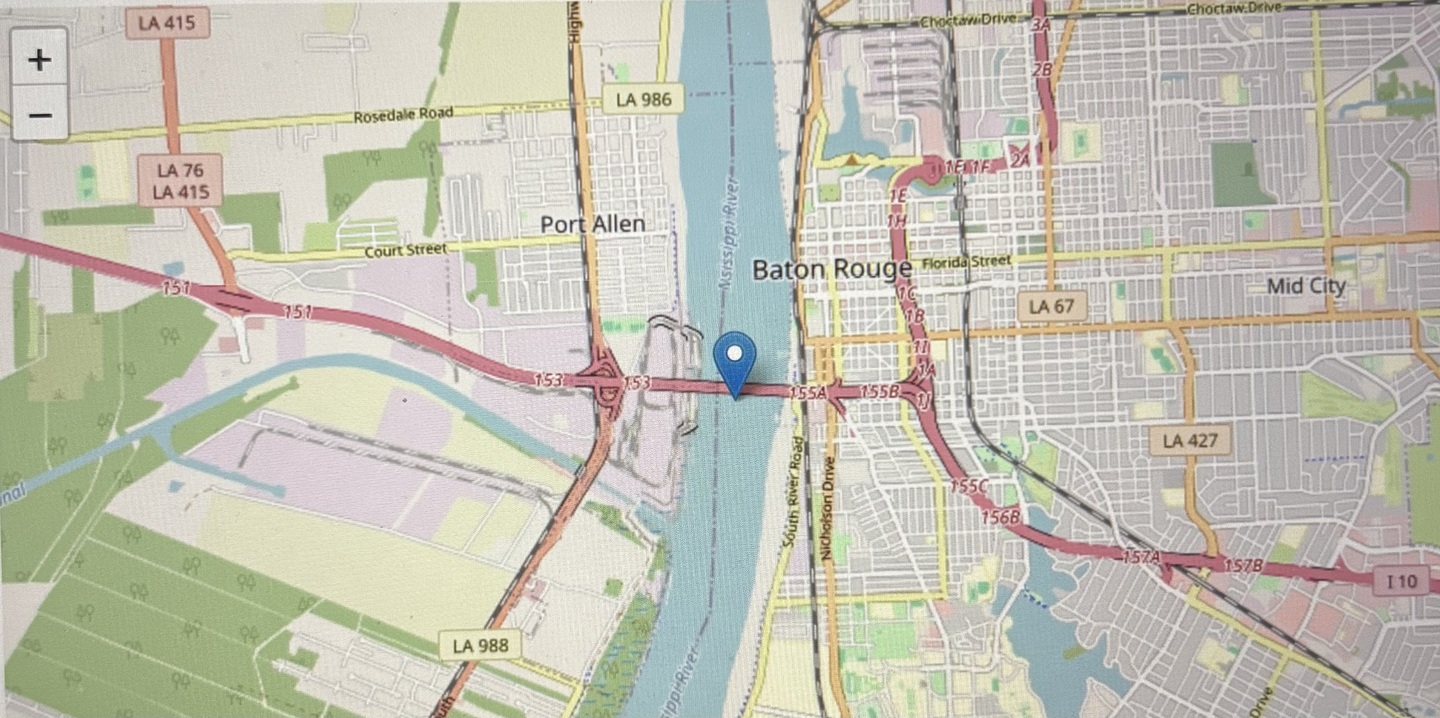
The Horace Wilkinson Bridge, also known as the “New Bridge,” runs along Interstate 10, connecting Port Allen (West Baton Rouge Parish) to Baton Rouge (East Baton Rouge Parish). The 14,150-foot (2.5-mile) cantilever steel truss bridge rises 175 feet above the Mississippi River. It features a 4,550-foot superstructure and a 1,235-foot clear span, with an overall width of 500 feet. The bridge carries six lanes of traffic. Plans to build the bridge began in the early 1960s.
Before the Horace Wilkinson Bridge was built in 1968, travelers depended on the Huey P. Long–O.K. Allen Bridge, which opened in the 1940s and became known as the “Old Bridge.” Over the years, the region experienced an increase in highway and waterway traffic that the Old Bridge could no longer sustain. Traffic congestion and bottlenecks worsened, placing strain on Baton Rouge’s infrastructure. As a result, the Louisiana Department of Highways proposed and commissioned the construction of a “New Bridge” to reduce congestion throughout the region.
In 1960, plans to build the new bridge began. The Louisiana Department of Highways partnered with Modjeski and Masters, which designed the bridge, while construction was carried out by the American Bridge Company. On March 21, 1963, work began on the bridge’s substructure units. Three years later, in January 1966, contractors started on the superstructure. Construction was completed in February 1968, and the bridge opened on April 10, 1968. In total, the project cost $15,574,174.
Despite the bridge’s architectural significance and its role in reducing traffic congestion and expanding infrastructure, the Louisiana Legislature passed Act 206 of 1968 to officially name the “New Bridge” the Horace Wilkinson Bridge. The bridge was named to honor and preserve the memory of three generations of the Wilkinson family: Horace Wilkinson Sr. (1854–1941), Horace Wilkinson Jr. (1888–1966), and Horace Wilkinson III (1913–1961). They were father, son, and grandson, respectively, and all three served in the Louisiana Legislature. Collectively, they served a total of fifty-four years. In addition to their legislative service, they were prominent figures in the Baton Rouge metropolitan area.
Horace Wilkinson Sr. (1854–1941) was born on Point Celeste Plantation in Plaquemines Parish. Before entering politics, he was a well-known planter. In 1883, he married Julia Merwin of New Orleans and moved to West Baton Rouge. Between 1884 and 1900, he managed Poplar Grove Plantation in Port Allen before returning to Plaquemines Parish for three years. In 1905, he returned to West Baton Rouge and purchased Poplar Grove Plantation. Around this time, he became actively involved in his community.
Horace Wilkinson Sr. was an advocate for Louisiana’s agriculture and infrastructure. He served as a member of the West Baton Rouge Parish Police Jury, as president of the Atchafalaya Basin Levee Board, and as president of the Choctaw Drainage Board. He was also elected to the Louisiana Constitutional Convention and served for twenty-one years in the Louisiana Legislature.
During his time in the legislature, Horace Wilkinson Sr. advocated for improved drainage systems, bridges, and roads. In 1918, during the administration of Ruffin Pleasant, he introduced a bill to purchase the Gartness Plantation in south Baton Rouge; this land later became the site of Louisiana State University. During the administration of John Parker, Horace Wilkinson Sr. served as the manager of the Angola State Penitentiary.
As mentioned, the bridge is named after Horace Wilkinson Sr.’s son and grandson. Both Horace Wilkinson Jr. and Horace Wilkinson III also played important roles in the Louisiana Legislature. Horace Wilkinson Jr. (1888–1966) followed in his father’s footsteps. He was a well-known sugar planter who lived on Poplar Grove Plantation. Like his father, he served in the Louisiana Legislature for 16 years and was a member of the West Baton Rouge Police Jury. Horace Wilkinson Jr. also served on the LSU Board of Supervisors for fourteen years. He is credited with being the first planter in Louisiana to use sheep to control Johnson grass in sugarcane fields.
Horace Wilkinson III (1913–1961) attended LSU and graduated in 1936 with a degree in agriculture. Like his father and grandfather, he followed a career in public service. He served twelve years as a member of the West Baton Rouge Police Jury and became a member of the LSU Board of Supervisors in 1959. Horace Wilkinson III was also a member of the Farm Bureau, the American Sugar Cane League, the National Cattlemen’s Association, and Sigma Nu Fraternity.
He was active in Louisiana politics for several years and served as a Louisiana senator from 1952 to 1956. He was reelected in 1960 but died in 1961 before completing his term. In total, Horace Wilkinson III served ten years as a Louisiana senator. While delivering a speech in 1961, he died from a stroke.
Overall, the Wilkinson family contributed significantly to Louisiana politics, infrastructure development, and agricultural advancement. They were strong advocates for the state’s progress. The bridge was built in their honor and stands as a lasting tribute to their legacy.
The Horace Wilkinson Bridge is also a symbol of modern engineering advancements. It is one of the highest bridges that crosses the Mississippi River. Its cantilevered truss design allows it to support heavy loads while also providing clearance for ships navigating the river, helping to reduce ship-related accidents.
Despite the bridge’s impressive design and historical significance, travelers often face challenges when using it. Although it was built to help reduce traffic congestion, the route is now known for frequent daily traffic delays.
The increased volume of vehicles has led to traffic delays and accidents. The original design of the Horace Wilkinson Bridge allowed little room for emergency contingencies. In response, in recent years, efforts have been made to implement additional safety measures for the bridge. For example, in 2003, the merge between Interstate 10 East and Interstate 10 West was redesigned to improve traffic flow. However, heavy traffic congestion remains an ongoing issue.
Currently, efforts to improve the bridge and make it safer for travelers continue to be an important focus. The Horace Wilkinson Bridge is a significant structure in the Baton Rouge area. It represents the legacy of the Wilkinson family and their efforts to improve the region. Overall, the bridge stands as a symbol of human ingenuity and progress.
Files
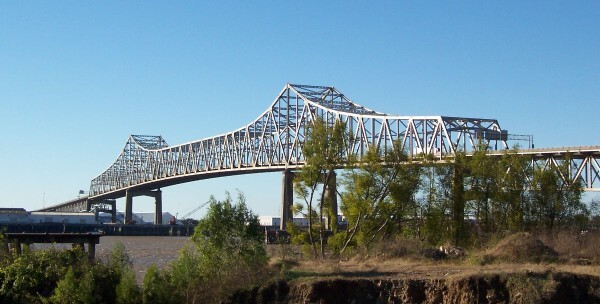
Horace Wilkinson Bridge
A photograph of Horace Wilkinson Bridge from the east bank. c. November 28, 2003 | Source: https://michaelminn.net/structures/horace_wilkinson_bridge/index.html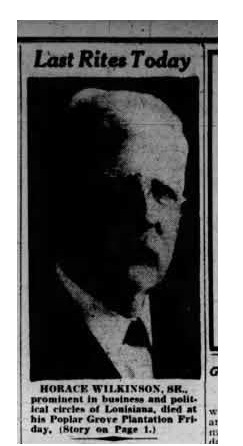
Horace Wilkinson Sr.
Horace Wilkinson SR. prominent in business and political circles of Louisiana, died at his Poplar Grove Plantation Fri. day. (Photograph of Horace Wilkinson Sr. use for his obituary) c. December 27, 1941 | Source: https://acadianahistorical.org/admin/files/edit/2278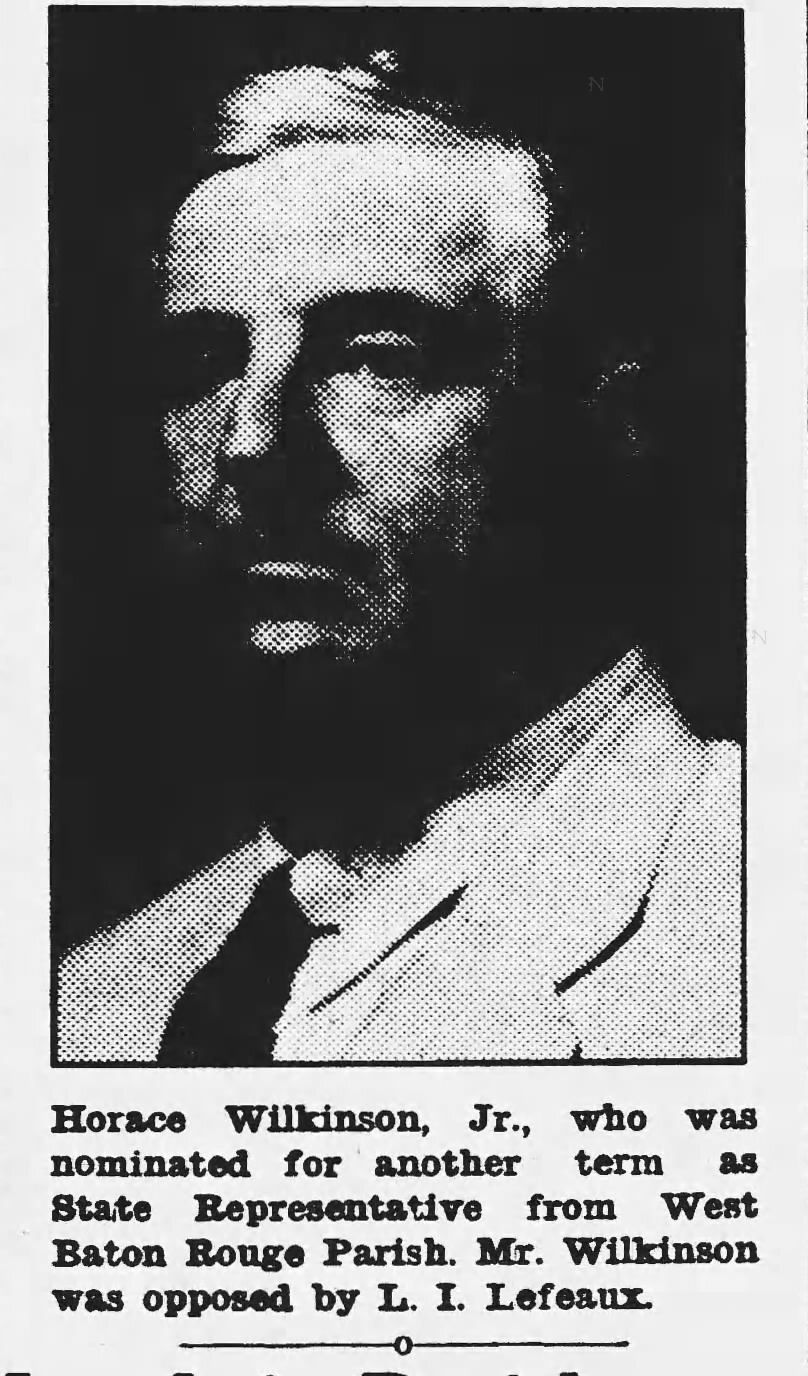
Horace Wilkinson Jr.
Horace Wilkinson, Jr., who was nominated for another term as State Representative from West Baton Bouge Parish. Mr. Wilkinson was opposed by L. I. Lefeaux. c. January 17, 1940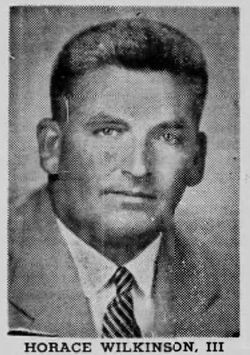
Horace Wilkinson III
A photograph of Horace Wilkinson III used for the announcement of his death. C. November 2, 1961 | Source: https://www.newspapers.com/image/854113961/?match=1&terms=horace%20wilkinson%20III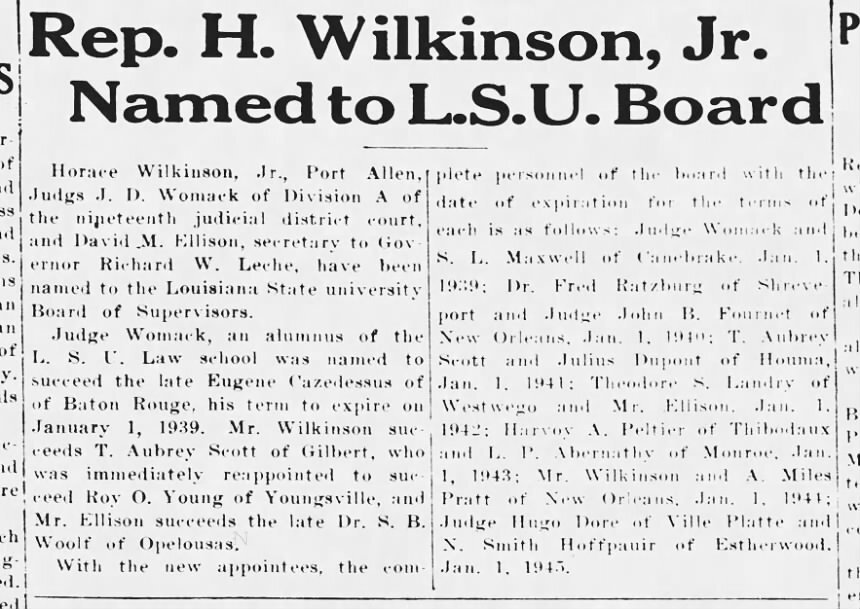
Horace Wilkinson Jr.
A newspaper clipping of the announcement of Horace Wilkinson Jr. named to the L.S.U Board. c. July 15, 1938. | Source: https://www.newspapers.com/image/855586106/?match=1&terms=Horace%20Wilkinson%20Jr.%20