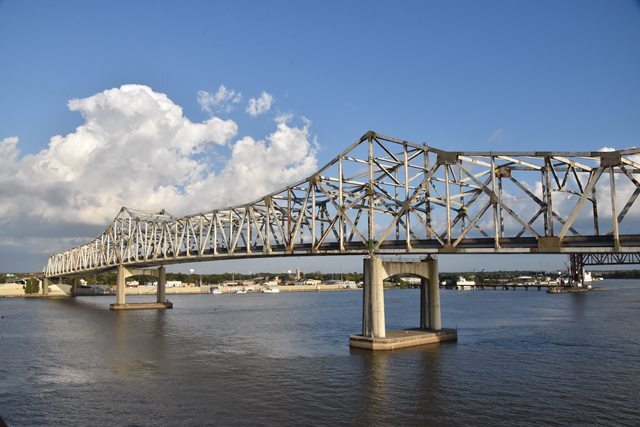
E.J. "Lionel" Grizzaffi: The Man who gave a life of Service in Morgan City
Emanuel Joseph “Lionel” Grizzaffi was a Morgan City civic leader whose life combined business, public service, and community involvement.
Text
Emanuel Joseph “Lionel” Grizzaffi was born on August 30, 1901, in Morgan City, Louisiana. At the time, the town was growing quickly as a port along the Atchafalaya River. Fishing, shrimping, and maritime trade drove the local economy. Shipyards lined the riverbanks, building and repairing vessels used across the Gulf Coast. Growing up in this environment, Grizzaffi learned early how important waterways and transportation were to coastal life.
His family operated a shipyard in Morgan City. This placed them at the center of the town’s river-based economy. Boats needed constant repair, especially those used in shrimping and shipping. As a result, shipyards were essential to daily life. Grizzaffi later recalled in a local interview that “the river was the town’s lifeline,” a phrase that reflected how deeply these industries shaped the community. That experience influenced his later interest in economic development.
As a young man, Grizzaffi also stood out on the baseball field. From 1919 to 1931, he played semi-professional baseball. Teams traveled from town to town, drawing large crowds. Games often turned into community events. Older residents remembered Grizzaffi as “a steady player who could always be counted on in a tight game.” His time in baseball helped him build connections across southern Louisiana.
Grizzaffi eventually turned his attention to civic leadership. In 1947, he helped establish the Morgan City–Berwick Chamber of Commerce and became its first president. In this role, he worked with business owners and local officials to promote growth. He also encouraged cooperation between Morgan City and Berwick, two towns separated by the river but closely connected in daily life.
His involvement in government followed soon after. From 1944 to 1948, he served on the St. Mary Parish Police Jury. This body handled local issues such as road maintenance, budgets, and public services. The experience gave him a direct role in shaping how the parish developed during a period of postwar growth.
Grizzaffi’s leadership extended beyond the local level. During the mid-twentieth century, coastal Louisiana was undergoing major changes. The expansion of the oil industry, improvements in highways, and increased demand for seafood all reshaped the region’s economy. Within this context, Governor Earl K. Long appointed Grizzaffi to the Gulf States Marine Fisheries Commission. There, he worked with representatives from other Gulf Coast states to manage fisheries and protect marine resources. In 1957, he served as chairman.
He also contributed to the Louisiana Game Fish and Oyster Committee. Over twelve years, he helped address issues affecting fishing and oyster harvesting. His work reflected a sustained commitment to balancing economic growth with resource management in a region that depended heavily on its natural environment.
Grizzaffi later served in the Louisiana House of Representatives. There, he focused on improving infrastructure and supporting regional development. His interest in transportation continued when Governor John McKeithen appointed him to the Louisiana Board of Highways. He served from 1964 to 1970, a time when the state was expanding its road network to meet growing demand.
One of the most pressing local challenges was crossing the Atchafalaya River. Morgan City and Berwick depended on each other, but travel between them was limited. As traffic increased along U.S. Highway 90, the need for a modern bridge became clear. Community leaders, including Grizzaffi, pushed for a solution.
When the new bridge was completed in 1975, it was named the E. J. “Lionel” Grizzaffi Bridge. The dedication recognized his many contributions to the region. A local newspaper later described the structure as “a link not just between two towns, but between past efforts and future growth.” Today, the bridge carries thousands of vehicles each day and remains a key part of the area’s infrastructure.
Even in his later years, Grizzaffi stayed active in public life. In 1975, he ran for the Louisiana State Senate in District 21. Although he did not win, the campaign showed his continued interest in serving the region.
Outside of public service, Grizzaffi was devoted to his family. He was married to Carrie C. Grizzaffi, and together they raised two children, Luke Joseph Grizzaffi and Virginia Grizzaffi Versen. Their lives reflected the close-knit nature of southern Louisiana communities, where family, church, and local ties were central.
On June 8, 1982, Grizzaffi and his wife were killed in a car accident in Morgan City. Their deaths deeply affected the community. They were buried in Morgan City Cemetery, alongside many generations of local families.
Today, the E. J. “Lionel” Grizzaffi Bridge stands as a lasting reminder of his contributions. From his early days in a shipyard family to his years in public leadership, he played a key role in shaping Morgan City. His work supported transportation, strengthened coastal industries, and encouraged regional cooperation. Through both his actions and his legacy, Grizzaffi helped guide his community through a period of important economic and social change.
Files
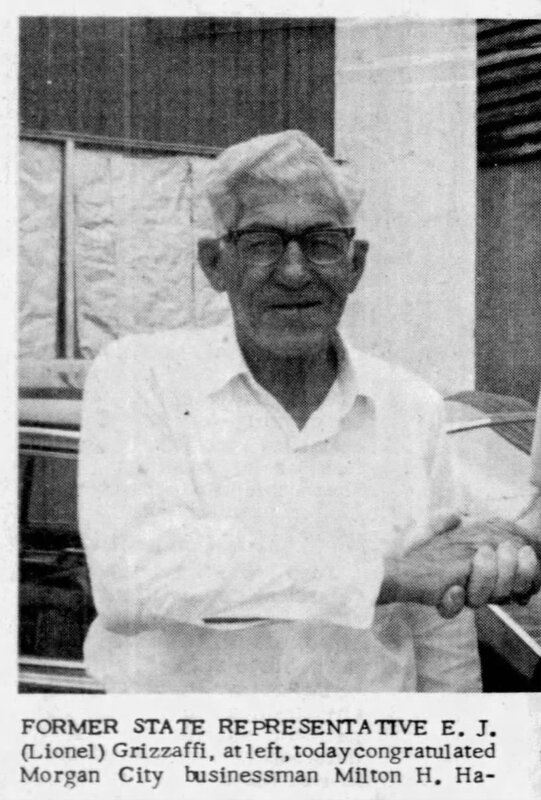
E.J. "Lionel" Grizzaffi
Shaking hands with a Morgan City businessman | Source: "The Daily Review", Morgan City, Louisiana, Sun, Jul 19, 1964, Page 1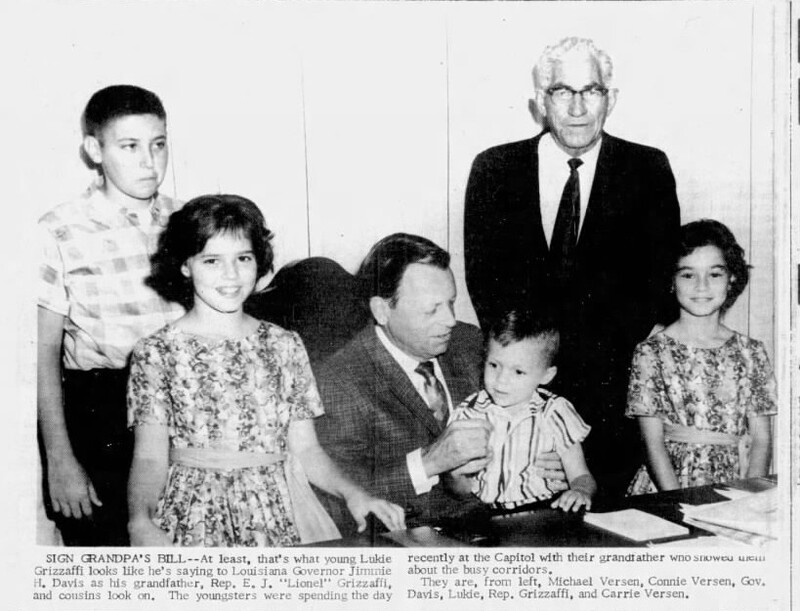
E.J "Lionel" Grizzaffi
Grizzaffi with grandkids and Louisiana Governor Jimmie H. Davis | Source: "The Daily Review", Morgan City, Louisiana, Wed, Jul 18, 1962, Page 1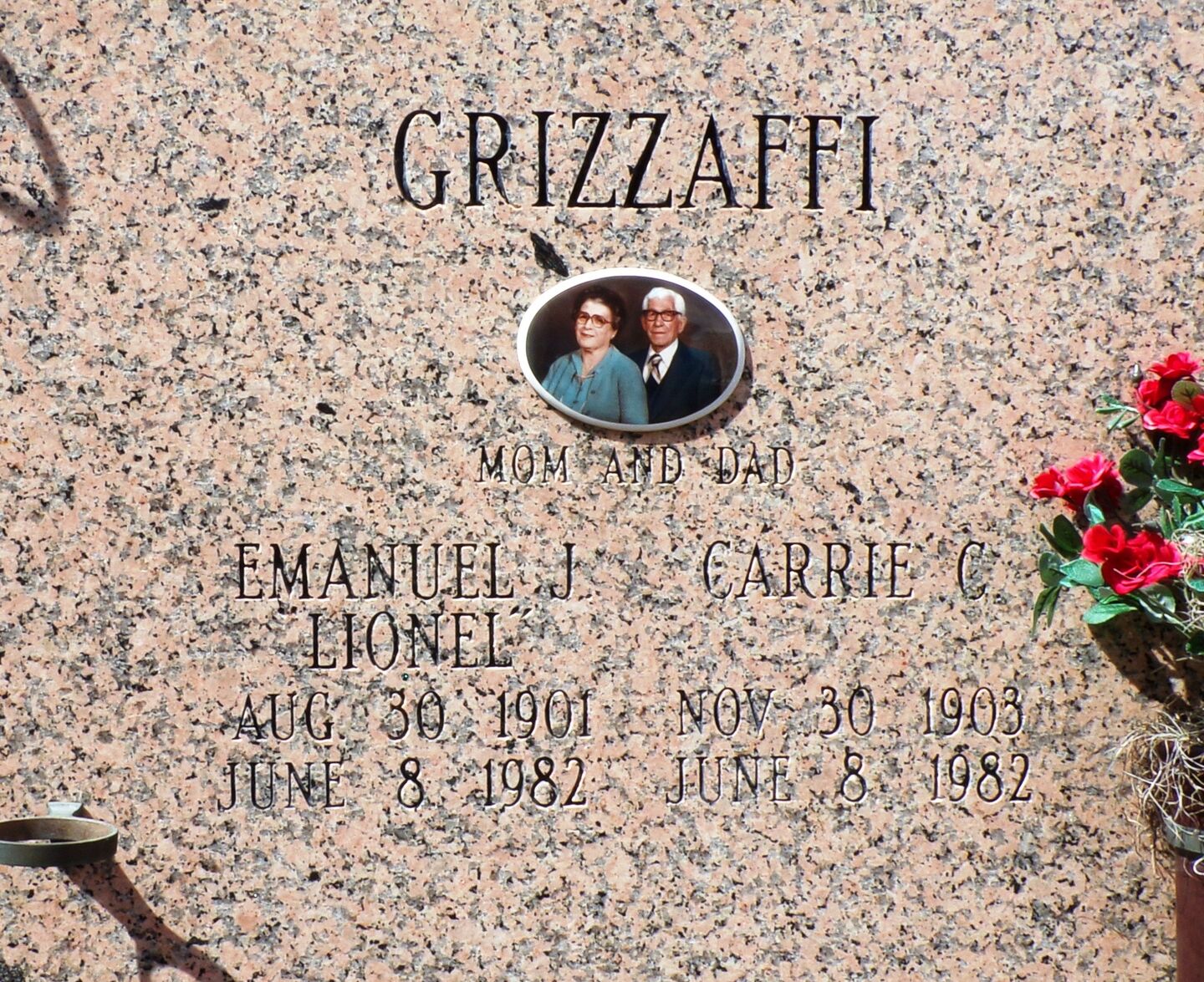
Grave Plot of E.J. Lionel and Carrie C. Grizzaffi.
Source: Find a Grave: Added on 29 Feb 2024