<?xml version="1.0" encoding="UTF-8"?>
<feed xmlns="http://www.w3.org/2005/Atom">
  <title type="text">Acadiana Historical</title>
  <updated>2026-03-04T22:42:50+00:00</updated>
  <generator uri="http://framework.zend.com" version="1.12.20">Zend_Feed_Writer</generator>
  <link rel="alternate" type="text/html" href="https://mail.acadianahistorical.org/"/>
  <link rel="self" type="application/atom+xml" href="https://mail.acadianahistorical.org/items/browse?output=rss2"/>
  <id>https://mail.acadianahistorical.org/</id>
  <author>
    <name>Acadiana Historical</name>
    <uri>https://mail.acadianahistorical.org</uri>
  </author>
  <link rel="hub" href="https://pubsubhubbub.appspot.com/"/>
  <entry>
    <title type="html"><![CDATA[Slim&#039;s Y-Ki-Ki: Zydeco&#039;s Highs and Lows in Opelousas]]></title>
    <summary type="html"><![CDATA[<p><strong><em>Once the heart of Opelousas nightlife, learn about the highs and lows of zydeco's favorite dancehall, Slim's Y-Ki-Ki and the club it used to be!</em></strong></p><img src="https://mail.acadianahistorical.org/files/fullsize/f5f2d4bc694c33187b77c624766f7db4.jpg" alt="Annexation Meeting in Opelousas" /><br/><p>In 2016, after an alleged 69 years of business, a dancehall once deemed the zydeco hotspot of the world, closed. Following a change in patrons’ behavior and attendance, St. Landry Parish’s weakening grasp on zydeco, and sharp increases in band prices, Anthony “Tony” Gradney, owner of Slim’s Y-Ki-Ki, made the hard decision to close doors permanently. The bar was originally owned and operated by Tony Gradney’s parents, Arnold “Slim” Gradney and Irene Pratt Gradney, who were both persons of color. In a 2004 newspaper piece written by Stephanie Kirk, Kirk notes the origin of the name “Slim’s Y-Ki-Ki” writing, “Slims took on the elder Gradney’s (Arnold “Slim” Gradney) name and interest. The second half of the club’s name ‘Y-Ki-Ki,’ came from Slim’s interest in Hawaii.” On October 16th, 1940, Arnold was drafted into the military. It is possible, though unverified, that his military experience took him to Hawaii where he gained the interest that led to his Club’s name.
In works by Herman Fuselier and journalist Stephanie Kirk, Slim’s allegedly started either in 1947 or 1949, though other evidence seems to counter those dates. In 1957, ten years after Slim’s earliest alleged start date, Arnold “Slim” Gradney, the original owner and founder of Slim’s Y-Ki-Ki, applied for a license to sell beer at the Murray Hill Club located in the same location as Slim’s. It is not until three years later, in 1960, that Arnold is witnessed applying for a license under the business Slim’s Y-Ki-Ki. The story gets even more interesting decades later, following an anniversary party and a statement from the owner. In the early spring of 1999, Slim's Y-Ki-Ki held a celebration for its 40th Year Anniversary. If that anniversary is accurate, that would put the start of Slim's Y-Ki-Ki in 1959, not ‘47 or ‘49. Five years later, in December of 2004, Anthony told reporters, "My daddy said Clifton Chenier was the first artist to perform at Slim's, in the early 1960s," and in the same newspaper column, Stephanie Kirk writes, "Slims was a rock 'n' roll club that began catering to zydeco lovers in the 1960s, just as the music genre began to thrive in St. Landry Parish." It would seem that Arnold Gradney originally opened the Murray Hill Club, a rock 'n' roll club, and turned that club into the legendary zydeco dancehall following local music trends. Though there still exists reasonable doubt, there were clearly some details about Slim's Y-Ki-Ki's origin that were yet to be fully explored.
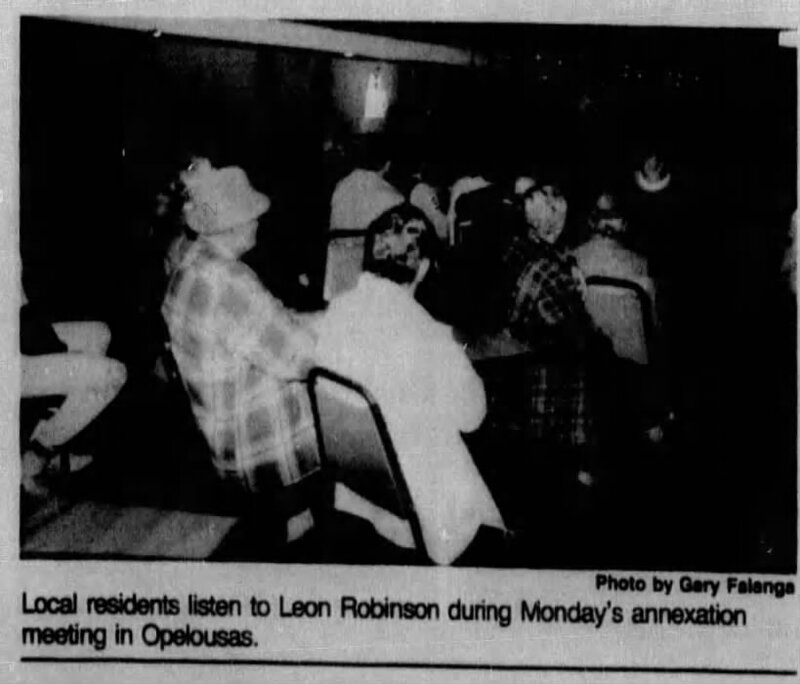
Slim’s Y-Ki-Ki was not only a worldwide beacon of zydeco, it, and its owner Arnold, were a pillar of the community. Unlike many dancehalls between the 1940's and 1990's, Slim's Y-Ki-Ki welcomed patrons of all races and had both Black and white guests grooving to the music together. The dancehall hosted public events, fundraisers, union rallies, holiday celebrations, marriage receptions, festival kickoffs, and even family reunions. These events ranged from a policemen's ball for the Colored Police Athletic Association to a Fontenot family reunion, and even included a city meeting protesting an Opelousas annexation ordinance. One consistent detail in all of these events, however, was music. Slim's Y-Ki-Ki boasted an impressive list of performers, many of which started their careers there. The sounds of Clifton Chenier, Beau Jocques, John Delafose and the Eunice Playboys, Rockin' Sidney, and so many more rocked the walls and shook the roof of Slim's. The famous dancehall even hosted multiple documentary films, including an HBO documentary titled "Finding the Grove" that featured 7-year-old Guyland Ledet playing the accordion and captivating the audience with such awe, there was a brief moment where people stopped dancing. 
Eventually, Slim's Y-Ki-Ki was laid to rest. Pressure from Lafayette and New Orleans began siphoning both zydeco players and enjoyers, and the new sound that began to fill the dancehall's wooden floors and open walls was silence. Slim's, which for decades hosted a packed house three to four nights a week, was lucky to have a large crowd even one night. Yet absence and losing business was not the only nail in the coffin. Anthony, when questioned on his decision to close the hall, noted increased band rates (often around $3500 or more) and unruly crowds helped affirm his choices in shutting down. Anthony is quoted saying, "It's a younger crowd and a lot of disrespect. They'll take off their shirt and want to dance with no shirt. It's not like it used to be with the older people....You're under four hours of nothing but stress now." Rather than try to keep it running until there's nothing left in the business or him, Anthony preferred to close it sooner and let the good memories sit forefront in peoples' minds.
The story of Slim’s Y-Ki-Ki is not shiny or explosive. It is not a story of particular grandeur that sets it apart from the rest of the world. Instead, Slim’s Y-Ki-Ki and its history is one of humility and community. Countless musicians, ranging from part-time players who no one knows to multiple grammy award winners to documentary subjects, played this dancehall. With every musician, Slim’s Y-Ki-Ki gained another story and gained more renown as newspapers referencing the dancehall’s legendary status. Festival kickoffs, holiday parties, wedding receptions, community fundraisers, political rallies, family reunions, all held within the walls of this historic business that now exists only in memory. To this day, people from all over Acadiana still reminisce on their personal stories related to the club, thinking back to the fun, dancing, and music that filled the air and lifted spirits.</p><p><em><strong><a href="https://mail.acadianahistorical.org/items/show/234">For more (including 9 images&#32;&amp;&#32;1 audio file) view the original article</a></strong></em></p>]]></summary>
    <published>2024-04-22T22:18:04+00:00</published>
    <updated>2026-03-04T22:42:50+00:00</updated>
    <link rel="alternate" type="text/html" href="https://mail.acadianahistorical.org/items/show/234"/>
    <id>https://mail.acadianahistorical.org/items/show/234</id>
    <author>
      <name>Xian C. Maynor</name>
    </author>
  </entry>
  <entry>
    <title type="html"><![CDATA[Rich History at the Royal Tavern: Twenty years of Roy Gathe&#039;s legacy, the Royal Tavern]]></title>
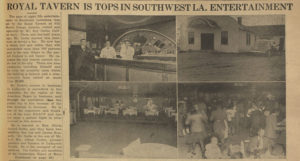
    <summary type="html"><![CDATA[<p><strong><em>Nightlife in Acadiana was especially dynamic and rich with complicated history. Many dancehalls, prior to the 1960s, were segregated or even white only, though one particular dancehall that opened sometime in the late 1930s not only welcomed Black patrons, but was owned by a Black family.  In its early days, the Royal Tavern was regarded as a pinnacle of high-class entertainment in Lafayette. As the dancehall changed hands and became more established in the Lafayette community, vices of the night, including illegal alcohol sales, prostitution, violence, and narcotics changed the place the Royal Tavern held in the community. </em></strong></p><img src="https://mail.acadianahistorical.org/files/fullsize/20b325e8284894acaa4ee3926b7d976e.jpg" alt="Photo of the Royal Tavern. " /><br/><p>Decades ago, music and dance were the epitome of South Louisiana’s nightlife. People from various parishes would travel miles to go to the ultimate hub of music and dance, the Louisiana Danchall. While the total number of dancehalls that have existed in Louisiana is rather impossible to know, some dancehalls have become quite popular in contemporary life and historical attention, while others have been borderline lost to the ravages of time. One such dancehall, that many have forgotten, sat in the heart of Lafayette, Louisiana, the Royal Tavern.</p><p>The Royal Tavern’s true location is still to be determined, though records have placed it on the Carencro highway, 615 North College Avenue, and Gilman Road. Interestingly, it’s location at 615 North College Avenue is right where the University of Louisiana Lafayette’s soccer and track field are currently located. The bar was started by Mr. Roy Gathe of the prominent Gathe farming family. The bar seemingly began in 1938 or ’39, with the earliest record of the existence being an advertisement for a whiskey brand called Old Schenley. Patrons of the bar, in 1942, described the bar as “high-class entertainment” owing testament to Mr. Roy Gathe’s activism in the community and his business ingenuity, having even helped start Lafayette’s NAACP chapter. As a testament to the "high-class" nature of the dancehall, the Royal Tavern owned the first remote-controlled music box in the city. In 1943, Roy Gathe joined the military and the ownership changed hands, with the next owner being listed as Relic Dartez in 1952. Over the years, two other owners, Milton Cormier and Russel Malbreaux (both Black), would be named as operators of the location, involved in a multitude of scandals.
The first recorded scandal being a prostitution raid in 1950, where a total of fourteen women were arrested over five separate locations including the Royal Tavern. Under these new owners, several more police raids would prove successful in finding illegal substances and dealings. In 1951 and ’52, narcotics busts at the Royal Tavern resulted in the arrest of over twenty-six men and women, among which was owner Relic Dartez. After this date, Milton Cormier was recorded as the operator of the tavern. From 1953-56, under Milton Cormier’s gaze, violence and thievery plagued the Royal Tavern as three fights resulting in stabbings occurred, and a group of thieves broke in and stole $8-9 in cash and three cases of beer. Additionally, the Royal Tavern and Milton Cormier were fined $50 for operating and selling alcohol on a Sunday, against Sunday Law.
The last records of the Royal Tavern are in 1957 and ’59 when Russel Malbreaux was listed as the bar’s operator applying for a license to sell alcohol, and listed in the city directory. The Royal Tavern has a rich and colorful history as a respectable dancehall in the beginning, and a patron of illicit substances, sex work, and violence in its later years. This dynamic history is a prime example of night life in Acadiana and the place many dancehalls held in communities. People would flock to these locations to dance and relieve their stress, and often times that release would result in arrests and pain.</p><p><em><strong><a href="https://mail.acadianahistorical.org/items/show/218">For more (including 3 images&#32;&amp;&#32;1 audio file) view the original article</a></strong></em></p>]]></summary>
    <published>2024-04-04T00:16:04+00:00</published>
    <updated>2026-03-04T22:42:49+00:00</updated>
    <link rel="alternate" type="text/html" href="https://mail.acadianahistorical.org/items/show/218"/>
    <id>https://mail.acadianahistorical.org/items/show/218</id>
    <author>
      <name>Xian Maynor</name>
    </author>
  </entry>
</feed>